
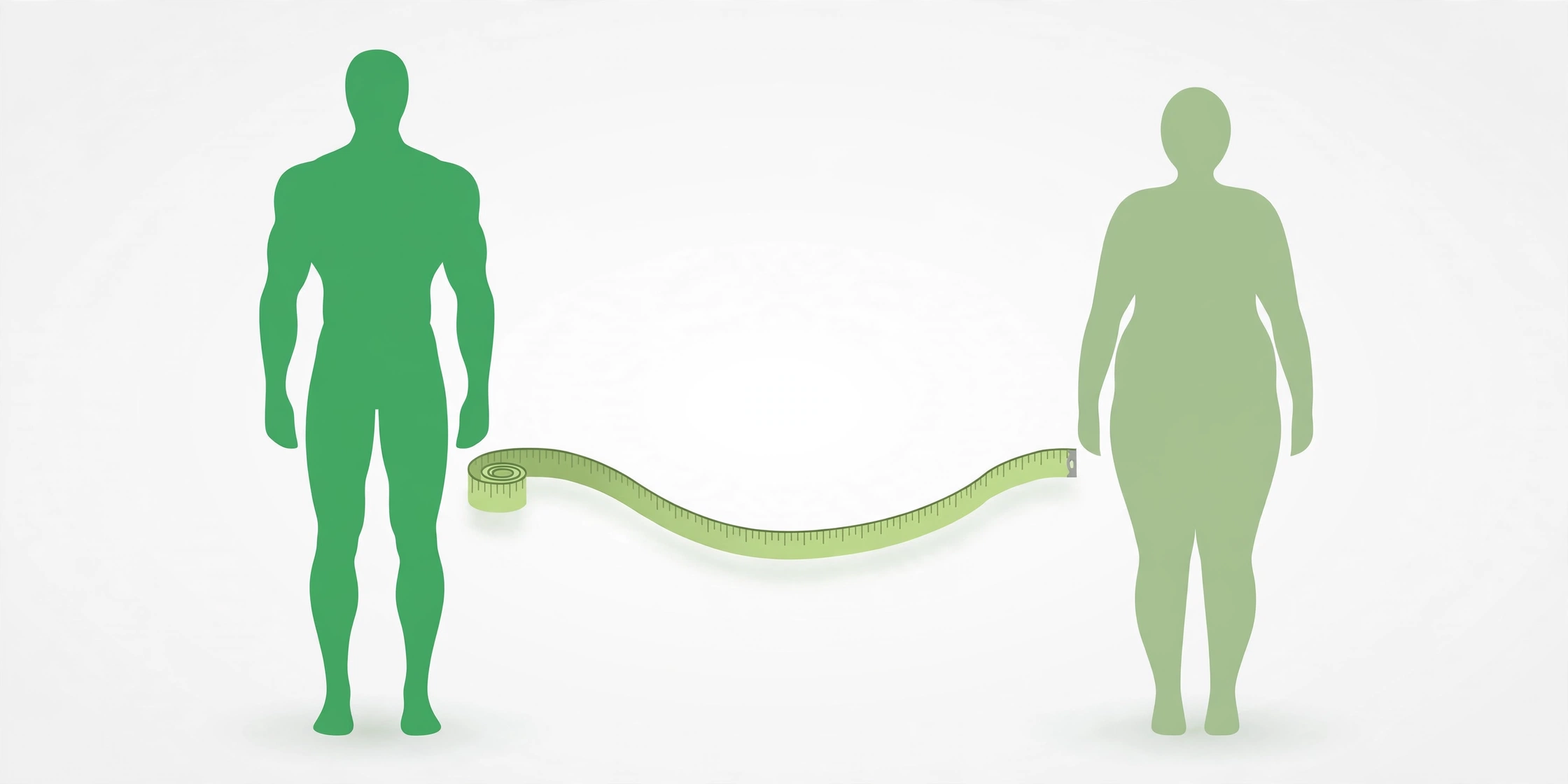
BMI tells you how your weight compares to your height, while body fat percentage tells you how much of that weight is fat versus muscle, bone, and water. In the BMI vs body fat debate, both metrics can be useful, but for tracking real fat loss progress, body fat percentage usually gives a clearer picture than BMI alone.
What BMI Actually Measures
Body Mass Index (BMI) is a simple formula: your weight in kilograms divided by your height in metres squared. It was developed in the 1830s by the Belgian statistician Adolphe Quetelet as a quick way to describe populations — not individuals. Today it is still the most widely used screening tool for weight categories:
- Below 18.5 — underweight
- 18.5 to 24.9 — healthy weight range
- 25 to 29.9 — overweight
- 30 and above — obesity
BMI is fast, free, and requires nothing but a scale and a tape measure. If you want your number in seconds, try our BMI calculator — but read on before you judge yourself by the result.
The Limits of BMI
In the BMI vs body fat debate, BMI's biggest weakness is simple: it cannot tell fat apart from muscle. Two people can share the exact same BMI and have completely different bodies. That leads to some well-known blind spots:
- Muscular people look "overweight." Muscle is denser than fat, so people who lift weights and athletes often land in the overweight or even obese BMI range while being very lean.
- "Skinny fat" goes undetected. Someone with a "healthy" BMI can still carry a high percentage of body fat and low muscle mass — a combination research links to poorer metabolic health.
- Age changes the picture. Older adults naturally lose muscle, so the same BMI can mean more fat at 65 than it did at 25.
- It ignores fat distribution. Belly (visceral) fat carries more health risk than fat on the hips and thighs, but BMI treats all weight the same.
None of this makes BMI useless — it is still a decent population-level screening tool — but for personal decisions about your body, it is only half the story.
BMI vs Body Fat: What Body Fat Percentage Tells You
Body fat percentage is the share of your total weight that is fat tissue. Where BMI asks "how much do you weigh for your height?", body fat percentage asks "what is that weight made of?" — and that second question is usually the more useful one for health and fat loss.
A certain amount of fat is essential: roughly 3–5% for men and 10–13% for women, needed for hormones, insulation, and organ protection. Beyond that, fat is stored energy — and where it is stored matters. Visceral fat around the organs is more strongly linked to health risks than subcutaneous fat just under the skin.
Healthy Body Fat Percentage Ranges
Commonly cited healthy ranges (such as those published by the American Council on Exercise) vary by sex and age:
- Men 20–39: 8–19% · 40–59: 11–21% · 60+: 13–24%
- Women 20–39: 21–32% · 40–59: 23–33% · 60+: 24–35%
- Athletes often sit below these ranges; fitness-level adults sit near the lower end.
Different sources publish slightly different tables, so treat these as orientation rather than medical cut-offs.
How to Measure Body Fat at Home
You do not need a lab to get a useful estimate. Here are the most practical options, from simplest to most precise:
- Tape-measure methods. The US Navy formula uses waist, neck, and (for women) hip measurements to estimate body fat. It costs nothing and tracks trends well.
- Waist-to-height ratio. Keep your waist circumference below half your height. It is a quick proxy for abdominal fat that research suggests predicts health risk better than BMI.
- Skinfold calipers. Cheap and reasonably consistent once you learn the technique — but results depend on who is doing the pinching.
- Smart scales (bioelectrical impedance). Convenient for daily tracking, but readings swing with hydration, meals, and exercise. Compare readings taken under identical conditions.
- DEXA scan. The clinical gold standard, available at some clinics and universities — accurate, but not something you do weekly.
Whichever method you choose, consistency beats precision: measure at the same time of day, under the same conditions, and watch the trend over weeks.
BMI vs Body Fat: Which Metric Should You Track for Fat Loss?
For most people, the answer is both — plus your waistline. BMI and scale weight give you a quick, free trend line. Body fat percentage (or a tape-measure proxy) tells you whether the weight you are losing is actually fat rather than muscle — which is the whole point of fat loss.
This matters most during body recomposition: beginners who lift weights often see the scale stall while their waist shrinks and their strength climbs. BMI alone would call that "no progress." Body fat percentage tells the real story.
A practical tracking stack:
- Weigh yourself 2–3 times a week and watch the 2-week average.
- Measure your waist monthly and estimate body fat with a tape method.
- Take progress photos in the same light and pose.
- Track strength — if your lifts hold or rise in a deficit, you are likely keeping muscle.
To plan the deficit itself, pair your BMI check with a BMR and TDEE calculation to find your maintenance calories, then read our guide to a safe calorie deficit. And do not forget enough protein — it is the single best nutritional lever for keeping muscle while you lose fat.
Key Takeaways
- BMI compares weight to height; body fat percentage reveals what that weight is made of.
- BMI can misclassify muscular, older, or "skinny fat" individuals — it cannot see composition.
- Body fat percentage is usually the better metric for tracking real fat loss progress.
- Tape-measure methods and waist-to-height ratio give useful, free estimates at home.
- Track scale weight, waist, photos, and strength together — no single number tells the whole story.
Frequently Asked Questions
Q: Is BMI or body fat percentage more accurate?
A: Body fat percentage is generally more informative for an individual, because it distinguishes fat from muscle. BMI remains useful as a quick population screening tool, but it was never designed to diagnose any single person's health.
Q: Can you have a normal BMI and still be unhealthy?
A: Yes. This is sometimes called "normal weight obesity" — a healthy BMI paired with high body fat and low muscle mass. It is one of the strongest arguments for looking beyond BMI, since research links this pattern to poorer metabolic health.
Q: What is a healthy body fat percentage?
A: Commonly cited ranges are roughly 10–20% for men and 20–30% for women, with healthy values rising slightly with age. Athletes sit lower. Treat published tables as orientation, not medical diagnoses, and focus on your trend over time.
Q: How often should I measure my body fat percentage?
A: Every two to four weeks is plenty. Body fat changes slowly, and home methods have day-to-day noise from hydration and meals. Consistent conditions and long-term trends matter far more than any single reading.
Q: Does BMI work for muscular or athletic people?
A: Not well. Because muscle is denser than fat, strength athletes and regular lifters frequently land in the "overweight" BMI category while being lean and healthy. For active people, body fat percentage or waist measurements are far more meaningful.
Q: What is the easiest way to measure body fat at home?
A: A simple tape measure. Track your waist circumference (aim for less than half your height) or use the Navy tape-measure formula for a body fat estimate. Both are free, and for tracking change over time they beat an expensive gadget used inconsistently.
This article provides general information only and is not medical advice. If you have health concerns, speak with a qualified professional.






Comments (0)
No comments yet. Be the first to share your thoughts!
Leave a comment