

The short answer: Creatine is a natural compound stored in your muscles that helps regenerate ATP, your cells' quick energy source. Creatine monohydrate (3–5 grams daily) is one of the most researched sports supplements in the world. Evidence supports strength and power gains, while kidney-damage and hair-loss myths lack support in healthy people. It is not a steroid.
Creatine for beginners often starts with confusion: is it safe, does it work, is it some kind of steroid? Every gym has strong opinions. The good news: creatine is also one of the most studied supplements ever — so instead of guessing, we can look at what the research actually says.
One note first: this article is educational, not medical advice. Creatine is generally well tolerated by healthy adults, but talk to a doctor before starting any supplement — especially with kidney conditions, medications, or if you are pregnant or breastfeeding.
Key Takeaways
- Creatine is a compound your body makes and that you also get from meat and fish; it helps muscles quickly recycle ATP, their energy currency.
- The best-studied form is creatine monohydrate: 3–5 grams daily, with no loading phase required.
- Strong evidence supports benefits for short-burst strength and power performance and for muscle growth when combined with resistance training.
- Evidence is weaker for endurance exercise, and creatine is not a steroid — it does not work like one and is not banned in sport.
- Large reviews find no kidney harm in healthy adults; the hair-loss claim comes from one small study and is not established.
Creatine for Beginners: What It Actually Is
Creatine is a nitrogen-containing compound made mainly in your liver and kidneys from amino acids, and it is stored mostly in skeletal muscle. You also get it from food — red meat and fish are the richest sources. A meat-eater takes in roughly 1–2 grams per day from diet, while vegetarians and vegans typically take in much less and start with lower muscle creatine levels.
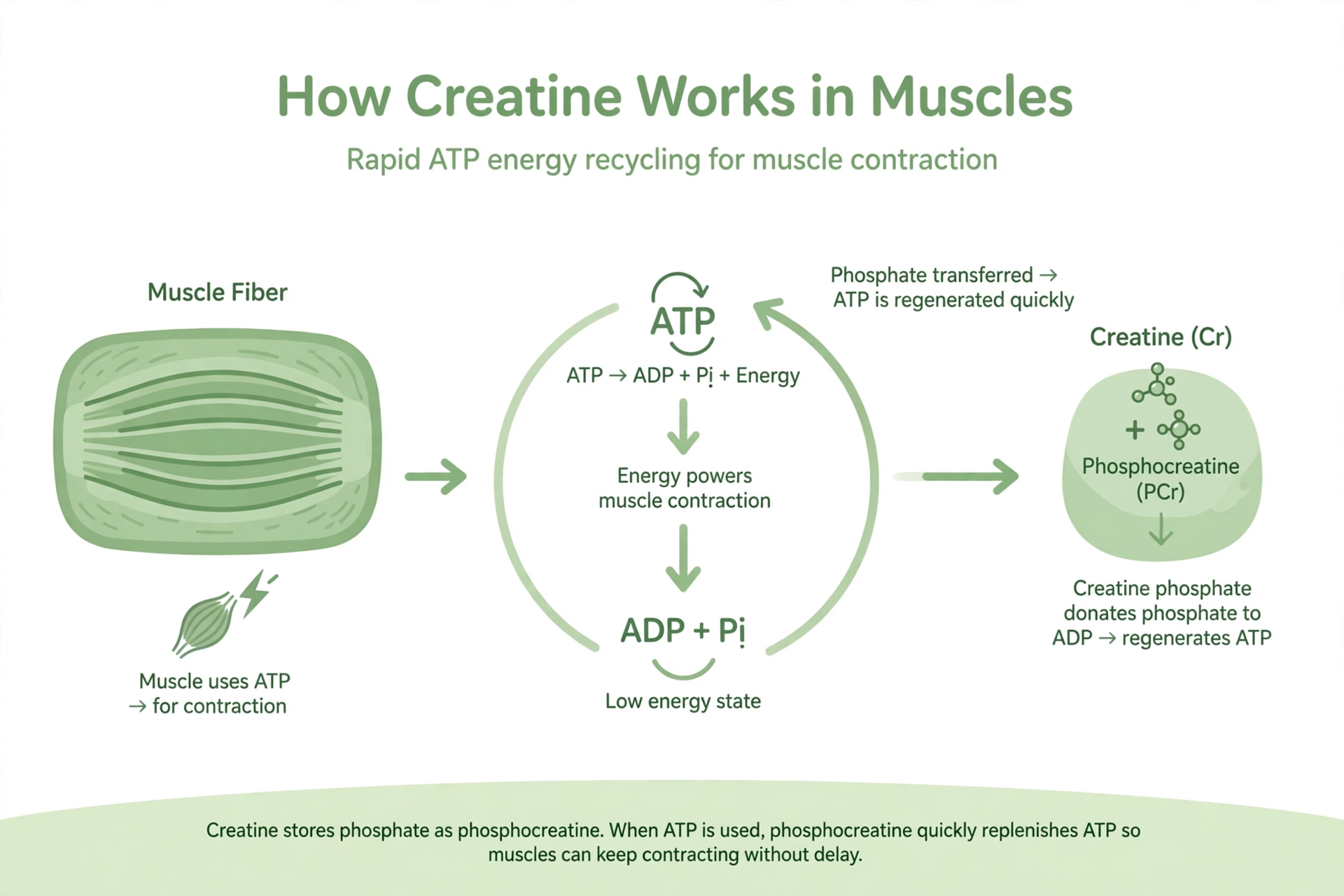
Inside the muscle, creatine acts like a rapid battery backup. Hard exercise burns ATP (adenosine triphosphate), your cells' energy currency. Stored creatine — phosphocreatine — donates a phosphate to rebuild ATP quickly, letting you squeeze out extra reps or a faster sprint.
Why monohydrate is the form to buy
Store shelves list dozens of creatine variants: ethyl ester, buffered, hydrochloride, micronized. Creatine monohydrate is the form used in the vast majority of research, it is the cheapest per serving, and alternative forms have not been shown to work better. For beginners, the choice is simple: plain creatine monohydrate powder.
Creatine for Beginners: What the Evidence Says It Does
Hundreds of trials and several large reviews agree: creatine improves short, intense efforts — heavy lifting, sprinting, repeated bursts — and supports strength and lean-muscle gains with resistance training. Meta-analyses typically find meaningfully greater strength gains in creatine groups than placebo groups on the same program.
The effects are smaller or uncertain for endurance sports like long-distance running, where ATP recycling speed is not the limiting factor. And creatine is not a steroid: it does not raise testosterone the way anabolic steroids do, it is not a banned substance in major sports, and it works through energy metabolism, not hormones. Some people gain 1–2 kg of body weight in the first weeks, mostly water drawn into the muscles — not fat.
Who benefits most
Anyone doing resistance or sprint-type training can benefit, but vegetarians and vegans often respond most noticeably because their starting muscle creatine is lower. Our strength training guide for beginners covers the kind of program creatine pairs with, and the AI workout plan generator can build one around your schedule.

Creatine for Beginners: How to Take It Safely
The standard, evidence-backed dose is 3–5 grams of creatine monohydrate per day. The old "loading phase" of 20 grams per day for 5–7 days saturates muscles faster, but it is optional — the same saturation happens in about 3–4 weeks at the regular daily dose, without the digestive discomfort some people get from loading.
Timing is not critical. Take it whenever you will remember: morning, pre-workout, or with dinner. Mixing with a meal or juice may slightly improve uptake, but consistency matters far more than timing. Dissolve the powder in water or juice; micronized versions dissolve more easily.
Hydration and everyday habits
Drink enough water — creatine pulls water into muscles, so hydration is the one practical rule. Track workouts in the exercise tracker over the first 8–12 weeks, and keep protein intake adequate (see our macros 101 guide): creatine supports training, not a poor diet.
Myths vs. Evidence: Kidney Damage and Hair Loss
Two fears dominate creatine conversations online, and both shrink under scrutiny.
Myth: creatine damages kidneys. Large reviews and long-term trials (up to several years) find no kidney harm in healthy adults at recommended doses. The confusion comes from creatinine — creatine breakdown raises blood creatinine, a rough marker of kidney function, not a sign of damage itself.
Myth: creatine causes hair loss. It comes from a single small 2009 study in rugby players that found raised DHT (a hormone linked to hair loss), without measuring hair loss itself. No follow-up research has established a link; reviews classify the claim as unproven.
Myth: it is a steroid. False. Steroids are synthetic hormones; creatine is a compound your own body produces. They share nothing but a place on the gym-supplement shelf.
Safety Notes and Who Should Be Careful
For healthy adults, creatine monohydrate is among the best-tolerated supplements on record — side effects are mostly mild stomach discomfort at high loading doses and temporary water-weight gain. People with existing kidney disease, those on kidney-affecting medications, and pregnant or breastfeeding women should not start without a doctor's guidance — evidence in these groups is limited.
Buy from reputable brands that use third-party testing (look for certifications on the label), since supplement quality varies. More is not better: doses above 5 grams daily offer no additional benefit and only increase cost and stomach upset.
Frequently Asked Questions
How much creatine should a beginner take?
Three to five grams of creatine monohydrate per day is the standard dose supported by research. A loading phase of 20 grams daily for 5–7 days reaches muscle saturation faster, but it is optional — the same level is reached in 3–4 weeks at the normal dose. Timing does not matter much; daily consistency does.
Is creatine safe for beginners?
For healthy adults, yes — creatine monohydrate has an unusually deep safety record, with trials lasting years showing no kidney, liver, or heart harm at recommended doses. It is not a steroid and is not banned in sport. People with kidney conditions, those on kidney-affecting medications, and pregnant or breastfeeding women should check with a doctor first.
Will creatine make me bulky or gain fat?
No. Creatine contains no meaningful calories and does not turn into fat. Many users gain 1–2 kg in the first weeks because creatine draws water into the muscle cells — this is intramuscular water, not fat, and it supports the very strength gains people take creatine for.
Do vegetarians need creatine more than meat-eaters?
Vegetarians and vegans typically have lower muscle creatine because meat and fish are the main dietary sources. Studies suggest they often see a bigger relative response to supplementation. Since most creatine monohydrate is made synthetically, it is generally considered vegetarian- and vegan-friendly — check the label to be sure.
Can I take creatine while trying to lose weight?
Yes. Creatine does not block fat loss; it supports training performance, which helps preserve muscle during a calorie deficit. The small water-weight gain may mask scale progress at first, so judge fat loss by measurements and photos rather than the scale alone. Pair it with adequate protein intake for best results.
How long does creatine take to work?
With a daily dose of 3–5 grams, muscles typically reach full saturation in about 3–4 weeks, and strength effects build from there. A loading phase shortens this to about a week. Give it at least 8–12 weeks of consistent use alongside a solid training program before judging results.
The Bottom Line
Creatine monohydrate is the rare supplement where beginner hype matches the evidence: cheap, well studied, and effective for strength and muscle growth with resistance training. Take 3–5 grams daily, stay hydrated, train consistently — and skip expensive "advanced" formulas. If you have a health condition or take medication, get your doctor's go-ahead first.






Comments (0)
No comments yet. Be the first to share your thoughts!
Leave a comment