
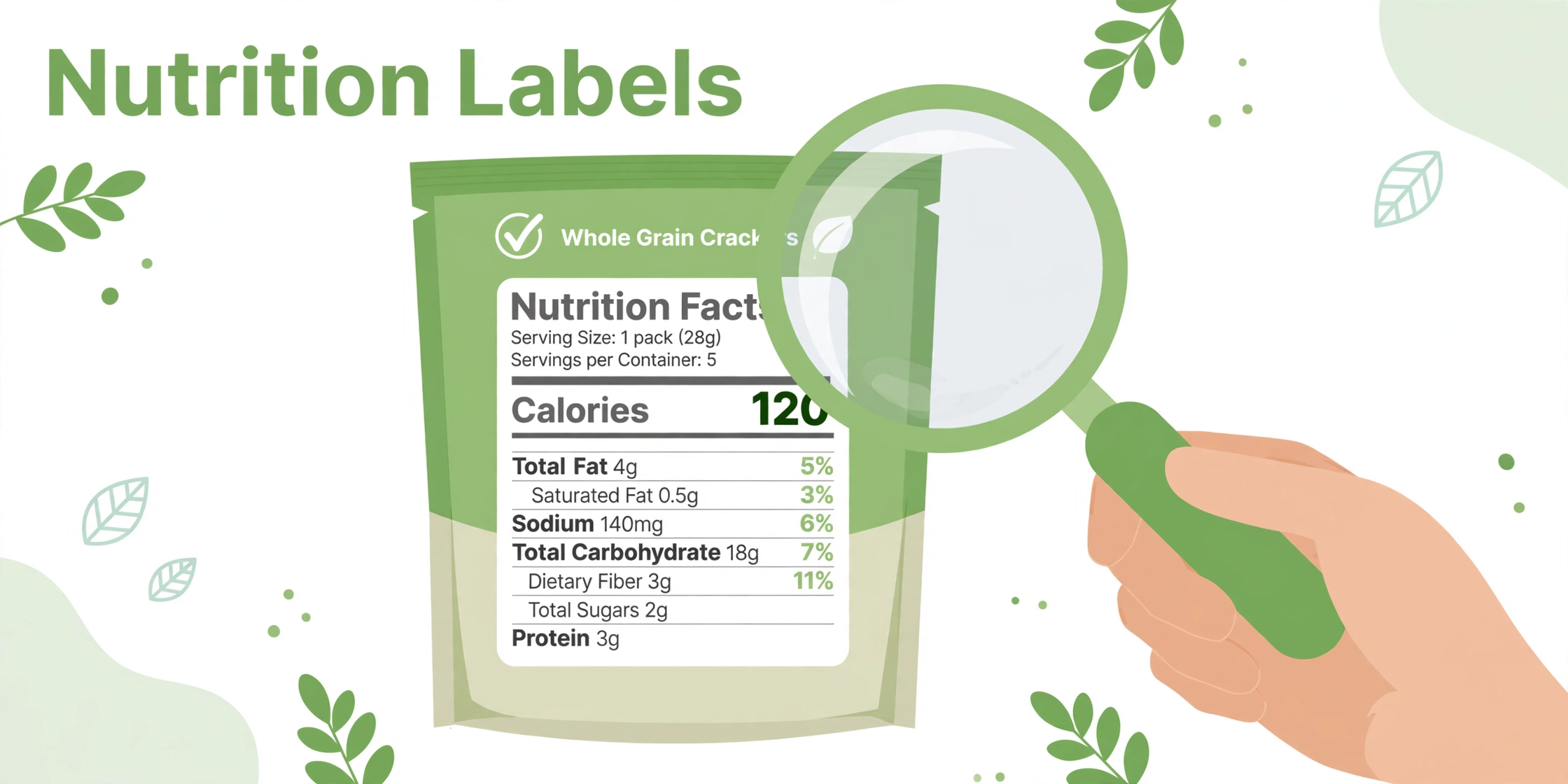
To read a nutrition label, start with the serving size, then check the calories per serving, the amounts of fat, saturated fat, sugars, salt, fibre, and protein, and the percent daily values. Finally, scan the ingredients list: the first items listed are the main ones. The whole process takes under a minute once you know what to look for.
How to Read Nutrition Labels: Start With the Serving Size
Every nutrition label begins with a serving size, and this single line changes the meaning of every number below it. A small bag of crisps might list 130 calories "per serving" while containing three servings in the bag — eat the whole bag and you have actually eaten 390 calories. Always multiply the label's numbers by the number of servings you really eat.
Serving sizes are set by regulation, not by appetite, so they are often smaller than what people actually eat. That is fine — the label is a standard ruler, not a recommendation. Your job is simply to compare the ruler against your real portion. If you eat twice the serving, double every number on the label.
A quick serving-size check
- Find "serving size" at the very top of the label.
- Check "servings per container" right below it.
- Estimate how much of the package you will actually eat, and scale the numbers up or down.
Calories: What the Number Actually Tells You
Calories are a measure of energy. The calorie count tells you how much energy one serving provides — no more, no less. It does not tell you whether the food is healthy; a handful of almonds and a sugary drink can have similar calories but very different effects on your body.
Use calories as a budgeting tool. If you are trying to lose weight, you generally want to consume fewer calories than your body burns; to maintain weight, aim for rough balance. To make that easier, you can look up a food's nutrition in our free tool before you buy or eat it, so there are no surprises.
The Big Six Nutrients to Check on Every Label
You do not need a nutrition degree to learn how to read nutrition labels. Focus on these six lines and you will understand roughly 90 percent of any packaged food.
1. Total fat and saturated fat
Fat is an essential nutrient, but the type matters. Saturated fat (in butter, fatty meat, palm oil) is linked to higher cholesterol levels when eaten in large amounts, so a lower number is generally better. Trans fat should ideally be zero.
2. Carbohydrates and sugars
"Total carbohydrates" includes starches, fibres, and sugars. Right beneath it you will see "sugars" — foods with a high sugar number relative to their total weight will raise your blood sugar quickly and leave you hungry again soon. We will dig into hidden sugars below.
3. Fibre
Fibre is the quiet hero of the label. Higher fibre means better digestion, steadier energy, and longer-lasting fullness. Wholegrain bread, oats, beans, and vegetables score well here; white bread and most pastries do not.
4. Protein
Protein keeps you full and supports muscles. As a rough rule, a solid protein source has at least 10 grams of protein per 100 grams (or per serving, on US-style labels). If you are active, this line deserves extra attention.
5. Salt (sodium)
Salt hides in bread, sauces, soups, and ready meals far more than in the salt shaker. High salt intake is linked to high blood pressure, so compare brands — two similar products can differ enormously here.
6. The percent daily value (% DV)
This column shows what share of your daily needs one serving covers. A simple rule of thumb: 5% DV or less is low, 20% DV or more is high. It is the fastest way to judge a nutrient at a glance.
How to Read Nutrition Labels to Spot Hidden Sugars
Sugar rarely announces itself plainly. Manufacturers use dozens of different names, which lets the same product sound low in sugar while containing a lot of it.
- Sugar by another name: glucose, fructose, dextrose, maltose, sucrose, syrup, cane juice, honey, agave, maltodextrin, and anything ending in "-ose" is usually a sugar.
- The split-sugar trick: a label may list three or four different sugars separately, so none of them appears first — but together they are the main ingredient.
- "No added sugar" is not "no sugar": fruit juice and dried fruit can be very high in natural sugars.
- Check grams, not claims: a "light" or "fitness" bar with 18 grams of sugar is still a sugary snack. Aim for under 10 grams of sugar per 100 grams as a rough guide.
What the Ingredients List Reveals (and What It Hides)
Ingredients are listed by weight, from most to least. The first three ingredients tell the real story of the product. If sugar (or one of its aliases) appears among them, the product is mostly sugar, whatever the front of the pack promises.
A short ingredients list of recognisable foods — oats, peanuts, dates — is usually a good sign. A long list of powders, numbers, and chemical-sounding names suggests a heavily processed product. Neither rule is perfect, but both are useful shortcuts.
Front-of-pack claims vs. the back of the pack
- "Low fat" often means extra sugar was added to keep the taste.
- "Natural" has no strict legal meaning in many countries — the label is what counts.
- "High protein" is only meaningful if the protein content is actually high per 100 grams.
- "Wholegrain" should mean whole grains are among the first ingredients, not just present in traces.
Your 3-Step Label-Reading Routine
Put it all together and reading a label takes less than a minute:
- Scale it: check the serving size and servings per container, then adjust the numbers to your real portion.
- Scan the big six: calories, saturated fat, sugars, fibre, protein, and salt — using the 5%/20% daily-value rule for a fast verdict.
- Read the first three ingredients: confirm the product is made mostly of food you recognise, and watch for hidden sugars.
Make it a habit and it becomes automatic. When you are planning your day's food, it also helps to log your meals — comparing labels first and tracking afterwards is how small, lasting changes are built. For a full walkthrough of our food database, see our guide on how to use the food nutrition lookup.
Key takeaways
- Start with the serving size and servings per container — every number below depends on it.
- Use the 5%/20% daily-value rule: 5% or less is low, 20% or more is high.
- Sugar hides under many names; check the grams per 100 g, not the marketing claims.
- The first three ingredients reveal what a product is really made of.
- Calories measure energy, not health — context from fat, fibre, protein, and salt completes the picture.


Comments (0)
No comments yet. Be the first to share your thoughts!
Leave a comment