
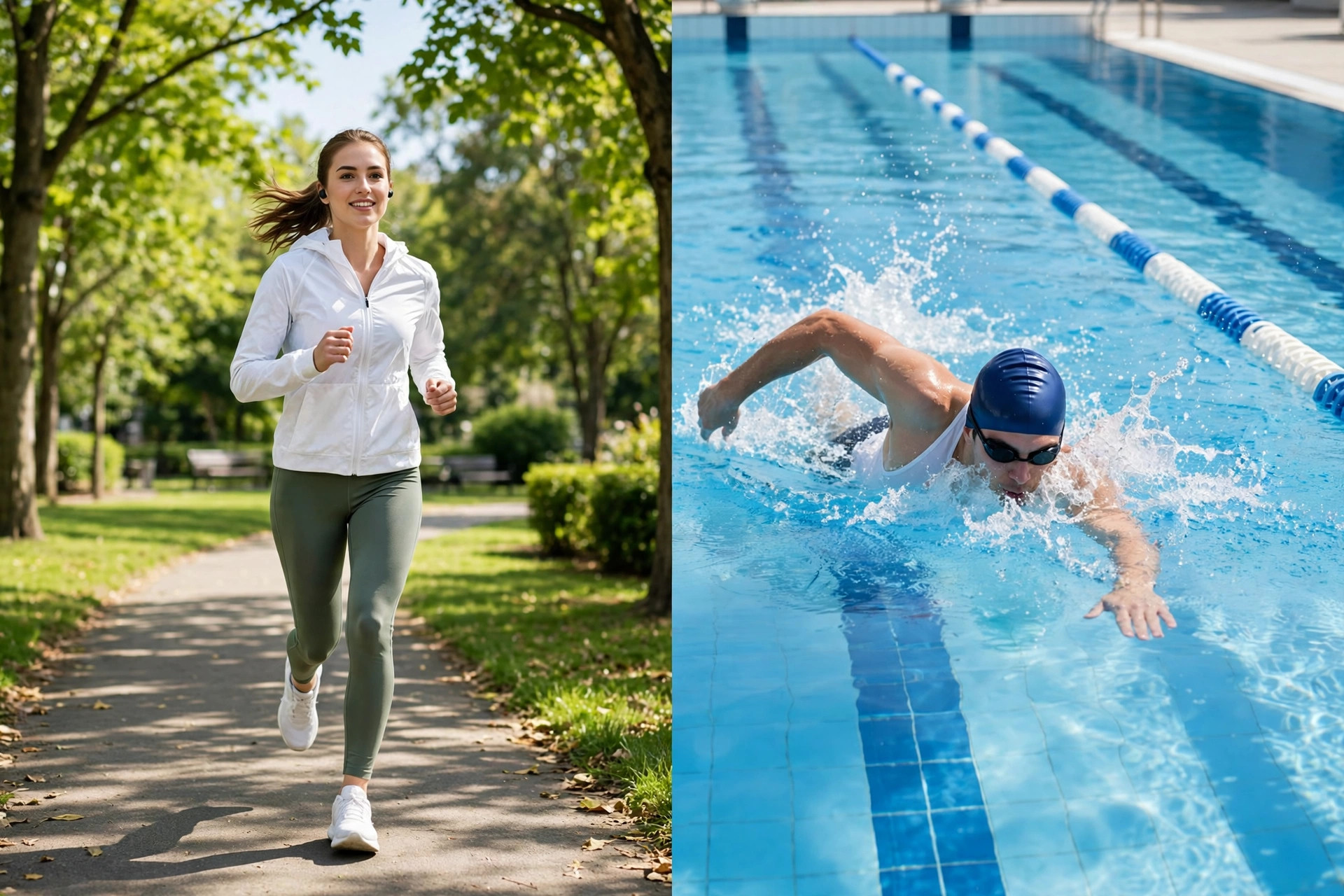
When comparing jogging vs swimming calories burned, jogging usually wins per minute: a moderate jog typically burns more than moderate swimming in the same time. But swimming is far gentler on joints, works your whole body, and is easier to sustain — so the best choice depends on your body, goals, and which you will keep doing.

Jogging vs Swimming Calories Burned: The Head-to-Head Numbers
Calorie burn depends mainly on body weight, speed, and effort, so there is no single exact number that fits everyone. As a rough guide, a moderate jog for 30 minutes burns roughly 280–420 calories for an average-sized adult, while moderate swimming for 30 minutes burns roughly 200–350 calories. Faster running widens the gap further, while vigorous swimming — such as fast freestyle or butterfly — can close it. These are approximate ranges, not promises: a heavier person burns more, a lighter person burns less, and a relaxed swim burns far less than a hard one.
The reason jogging usually scores higher is simple: you are carrying your full body weight against gravity with every step. In water, buoyancy supports much of your weight, so your body does less work just to stay upright — even though you are moving your arms and legs against water resistance. That is also exactly why swimming feels easier on the body while still giving you a real workout.
If you want a personal estimate rather than a rough range, try the exercise calorie calculator and compare it with your daily needs on the BMR and TDEE calculator. Seeing your own numbers makes it much easier to plan realistic sessions instead of guessing.
What Affects How Many Calories You Burn
Several factors shift the numbers up or down for both activities:
- Body weight: heavier bodies use more energy to move, in water and on land.
- Intensity: a slow jog and a sprint are different workouts, just as gentle breaststroke and fast freestyle are.
- Technique: efficient swimmers glide more and burn less; beginners work harder because they fight the water.
- Duration: swimming often wins on total time, because many people can swim comfortably for 45–60 minutes but tire after 20–30 minutes of jogging.
- Terrain and conditions: hills, heat, and wind raise jogging burn; cold water can raise swimming effort slightly.
This is why total weekly calories matter more than a single session. A sport you enjoy for an hour three times a week beats a "better" sport you quit after two weeks. For a broader comparison across activities, see our guide to calories burned walking, running, cycling and swimming.
Jogging vs Swimming Calories Burned and Joint Impact
Jogging is a high-impact activity: every stride sends force through your ankles, knees, hips, and lower back. For healthy joints this is not a problem — in fact, moderate impact can help keep bones strong — but it can aggravate existing knee, ankle, or back pain, and it demands good shoes and a gradual build-up.
Swimming is close to zero-impact. The water supports your weight, so your joints move through a full range of motion without pounding. That makes it a strong choice if you are returning from injury, carrying extra weight, dealing with arthritis, or simply want a workout that leaves you less sore the next day. Many people who cannot jog comfortably can swim pain-free.
A practical rule
If your joints feel fine and you recover well, jogging is a great calorie burner. If anything hurts during or after a jog, swimming — or alternating the two — is the smarter long-term choice. Pain that lasts more than a day or two is a reason to slow down and, if it persists, to talk to a health professional.
Muscles Worked: Full Body vs Lower Body
Jogging mainly works the lower body: calves, thighs, glutes, and core stability muscles. Your arms swing, but they are not the main engine. It is excellent for leg strength, stamina, and bone health.
Swimming is a genuine full-body workout. Freestyle and backstroke use shoulders, back, arms, and core along with a steady leg kick; breaststroke adds inner-thigh and hip work. Because water resists movement in every direction, you build balanced upper- and lower-body endurance without heavy weights. Swimmers often notice better posture and shoulder mobility over time.
Neither activity alone covers everything. Joggers benefit from some upper-body strength work, and swimmers benefit from weight-bearing exercise for bone health. Mixing the two, as in the plan below, covers more of the body than either one alone.
Accessibility, Cost, and Convenience
Jogging wins on simplicity. You need decent running shoes, a safe route, and you can start from your front door at any hour. There is no membership, no timetable, and no travel. The downsides are weather, darkness, air quality, and finding safe, pleasant routes.
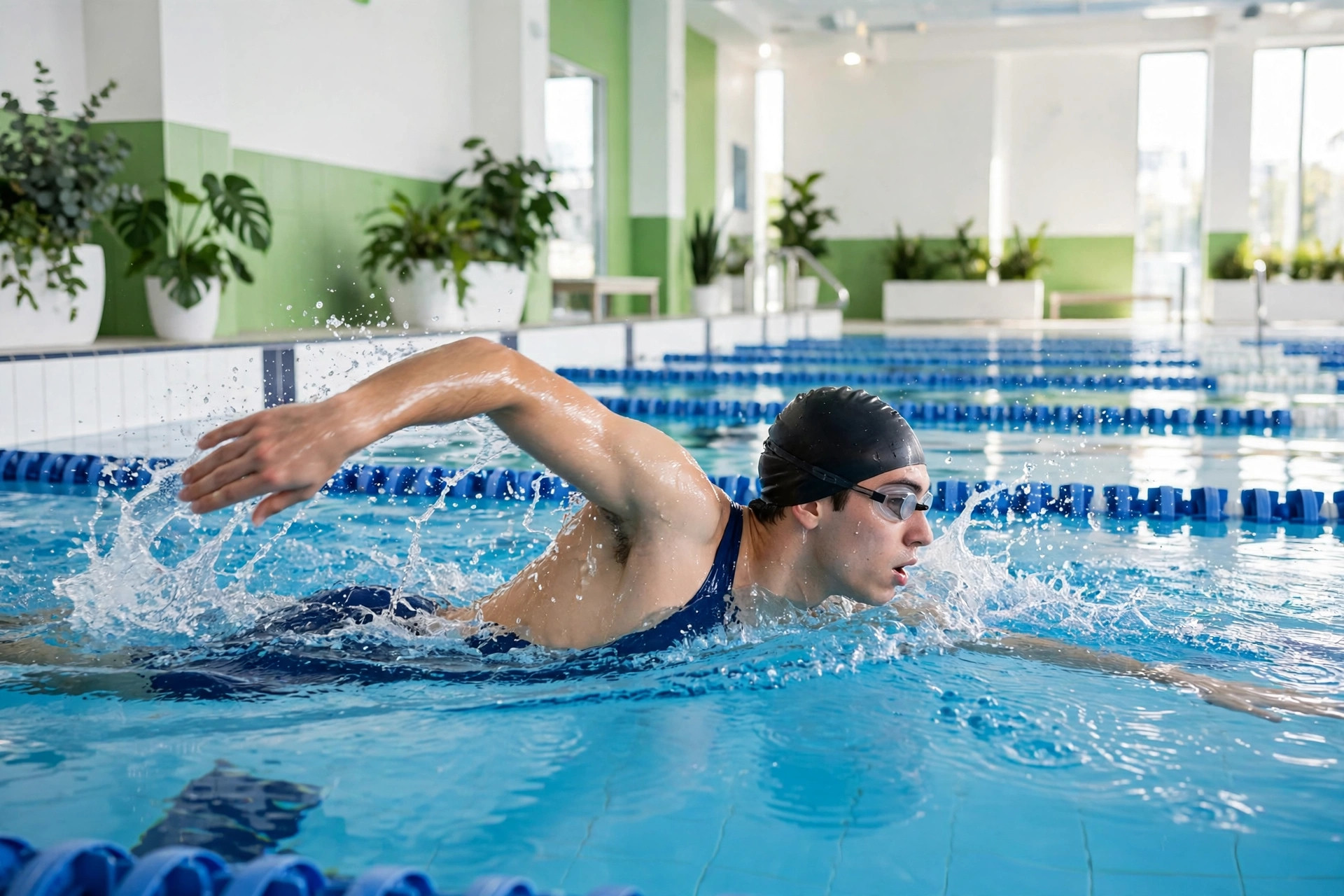
Swimming needs a pool, which usually means a membership or entry fee, set opening hours, and travel time. You also need basic technique: poor form makes swimming tiring and less effective, so a few beginner lessons are worth it. On the plus side, pools are open in all weather, the water keeps you cool, and many people find swimming calmer and more relaxing than running.
Time of day matters too. Some people jog best in the morning and swim best after work — or the reverse. Our guide on the best time to work out, morning vs evening, can help you match sessions to your energy peaks.
Which Should You Choose?
Choose jogging if your main goal is maximum calorie burn per minute, you have healthy joints, you want a free and flexible workout, and you enjoy being outdoors. Choose swimming if you want a joint-friendly full-body workout, you are easing back into exercise, you enjoy the water, or you want to train longer without soreness.
For weight loss specifically, the winner is the one you will do consistently. Jogging burns more per minute, but swimming sessions often last longer and feel easier to repeat. Pair either one with sensible eating — exercise alone rarely outruns a large calorie surplus — and track your total weekly activity rather than obsessing over one session.
A Simple Weekly Mix Plan
If you can do both, combining them gives you the calorie burn of jogging plus the joint-friendly full-body benefits of swimming. Here is a beginner-friendly week:
- Monday: 20–30 minutes easy jogging, with walking breaks as needed.
- Wednesday: 30 minutes easy swimming, alternating freestyle and backstroke.
- Friday: 25 minutes jogging, slightly faster than Monday.
- Sunday: 30–45 minutes swimming at a comfortable, steady pace.
Start slower than you think you need to, add no more than about 10% extra time per week, and keep at least one full rest day. Warm up for five minutes, cool down and stretch for five minutes, and drink water — yes, you still sweat while swimming.
Key Takeaways
- Jogging usually burns more calories per minute than moderate swimming, but vigorous swimming narrows the gap.
- Swimming is far gentler on joints and works the whole body; jogging mainly works the legs and supports bone strength.
- Jogging is free and flexible; swimming needs a pool but works in any weather.
- Total weekly minutes and consistency matter more than one session's calorie count.
- Mixing both gives you the best of each — burn, strength, and joint care.
Conclusion
So, jogging or swimming? For pure calories per minute, jogging takes the lead. For comfort, joint health, and full-body training, swimming is hard to beat. The best answer for most people is not either-or: jog when you want a fast, efficient burn, swim when you want a longer, gentler session, and combine both across the week. Pick the mix you enjoy, build it up gradually, and let consistency do the work.






Comments (0)
No comments yet. Be the first to share your thoughts!
Leave a comment