

To run your first 5K as a complete beginner, follow a 4-week run-walk plan: train three days a week, alternate short running intervals with walking breaks, and gradually lengthen the running parts until you can run continuously for 30 minutes — roughly the time most new runners need to cover 5 kilometres.
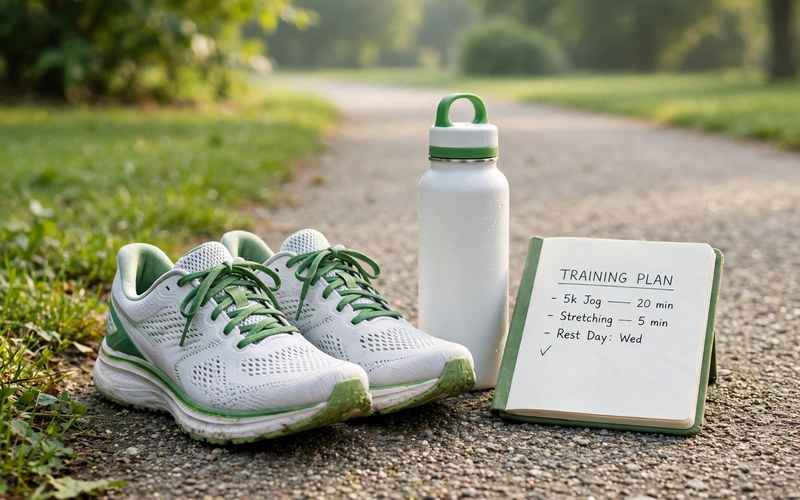
Key Takeaways
- A run-walk plan is the safest way for beginners to build up to 5K in four weeks.
- Train three days a week with a rest day between sessions — your body improves while you recover.
- Run at a comfortable, conversational pace: you should be able to talk in short sentences while running.
- Always warm up for 5–10 minutes before running and cool down with a gentle walk afterwards.
- Progress slowly and never increase your total weekly running time by more than about 10%.
- Comfortable shoes matter more than expensive gear — and a simple plan beats a perfect one.
Why a Run-Walk Plan Works for Beginners
Most people who try running for the first time make the same mistake: they run as fast as they can until they are out of breath, then quit because it feels awful. A run-walk plan avoids that trap completely. By breaking each session into short running intervals with walking breaks, you keep your breathing under control, your legs fresh, and the whole experience enjoyable. Over four weeks, the running intervals grow and the walking breaks shrink, so your fitness builds almost without you noticing.
Running also burns a serious amount of energy — if you are curious how it compares with other activities, see our guide to calories burned walking, running, cycling, and swimming. But for now, forget speed and distance targets: your only job in week one is to finish each session feeling good.
Before You Start: Gear and Warm-Up
You do not need fancy equipment to start running. The one thing worth getting right is your shoes: a pair of comfortable running shoes that fit well and feel good on your feet. Wear breathable clothes you can move in, and on sunny days, a cap and sunscreen. A simple sports watch or phone app can time your intervals, but a regular watch works fine too.
Never skip the warm-up. Start every session with 5–10 minutes of brisk walking, then a few gentle leg swings and easy mobility moves. Our 10-minute warm-up routine is a great template, and it sharply lowers the chance of pulled muscles and sore joints. Finish each session the same way: walk gently for 5 minutes and stretch lightly while your muscles are still warm.
Your 4-Week Running Plan
Train three days a week — for example Monday, Wednesday, and Friday or Saturday — with at least one rest day between sessions. Each session below includes a 5-minute warm-up walk and a 5-minute cool-down walk, which are not counted in the session times. Run at a slow, comfortable pace throughout.
Week 1: Get Moving
- Session 1: Alternate 1 minute of running with 2 minutes of walking, repeated 8 times (about 24 minutes).
- Session 2: Same as session 1 — 1 minute run, 2 minutes walk, 8 times.
- Session 3: Alternate 1 minute of running with 90 seconds of walking, repeated 9 times.
Week 1 is about learning the rhythm: if you feel breathless, slow down.
Week 2: Build the Habit
- Session 1: Alternate 2 minutes of running with 2 minutes of walking, repeated 7 times (about 28 minutes).
- Session 2: Alternate 2 minutes of running with 90 seconds of walking, repeated 8 times.
- Session 3: Alternate 3 minutes of running with 2 minutes of walking, repeated 6 times (about 30 minutes).
By week 2, the sessions start to feel like real training. Keep the pace conversational.
Week 3: Longer Runs
- Session 1: Alternate 5 minutes of running with 2 minutes of walking, repeated 4 times (about 28 minutes).
- Session 2: Alternate 8 minutes of running with 2 minutes of walking, repeated 3 times (about 30 minutes).
- Session 3: Run 10 minutes, walk 2 minutes, run 10 minutes (about 22 minutes plus walking).
Week 3 is the turning point. Ten-minute runs feel like a genuine achievement — because they are. Celebrate them.
Week 4: Your First 5K
- Session 1: Run 15 minutes, walk 2 minutes, run 10 minutes.
- Session 2: Run 20 minutes continuously, then walk 5 minutes.
- Session 3: Run continuously for 30 minutes — for most beginners, that covers close to 5 kilometres. Congratulations, you have run your first 5K!
If 30 minutes still feels out of reach at the end of week 4, simply repeat week 3 once more. There is no deadline. A plan finished one week late is still a plan finished.

Fuel, Hydration, and Recovery
For runs under an hour, you do not need special sports drinks or energy gels — plain water is enough. Drink a glass of water before you head out, carry water on hot days, and drink again afterwards. Eat a light meal or snack one to two hours before running (something simple like toast with banana or yoghurt with oats), and avoid a heavy meal right before a session.
Recovery is where the fitness actually happens. Sleep well, eat balanced meals with enough protein, and respect rest days. Mild muscle soreness in the first two weeks is normal and fades as your body adapts. Tracking your sessions helps too: our free calorie tracker lets you log your activity and food in one place, so you can see your progress week by week.
Common Beginner Mistakes to Avoid
- Running too fast — slow down until you can talk. Speed comes later, and only if you want it.
- Skipping rest days — running every day as a beginner is the fastest route to shin splints and burnout.
- Skipping the warm-up — cold muscles and sudden effort are a classic recipe for injury.
- Comparing yourself with others — your only competition is last week's version of you.
- Ignoring pain — soreness is normal, sharp or persistent pain is not. Stop and rest if something hurts.
- Doing too much too soon — stick to the plan, even on days you feel great. Enthusiasm is wonderful, but patience finishes 5Ks.
Note: this article is general information only, not medical advice. If you have a heart condition, joint problems, asthma, diabetes, or any other medical condition, or you have been inactive for a long time, talk to your doctor before starting a running programme. Stop running and seek medical advice if you feel chest pain, dizziness, or sharp joint pain.
Frequently Asked Questions
How long does it take a beginner to run 5K?
Most complete beginners can build up to a continuous 5K run in about four to eight weeks with three sessions per week. This plan aims for four weeks, but repeating a week is completely normal — fitness builds at different speeds for everyone, and arriving a week or two later still counts.
Should beginners run every day?
No. Three days a week with rest days in between is ideal for beginners, because your muscles, joints, and tendons need time to adapt to the new impact. Rest days are part of training, not a break from it. Once running feels comfortable, you can gradually add a fourth day.
What pace should a beginner runner aim for?
A pace where you can talk in short sentences — often called conversational pace. For most beginners this is somewhere around 7 to 9 minutes per kilometre, but the exact number does not matter. If you cannot speak, slow down; if you can chat easily, you are in the right zone.
Do I need expensive running shoes to start?
No. You need shoes that fit well, feel comfortable, and are designed for running rather than fashion or court sports. A mid-priced pair from a running shop is plenty to start with. Replace them roughly every 500–800 kilometres, or when the cushioning feels flat.
Is running bad for your knees?
For most healthy people, running does not damage the knees — in fact, regular runners often have stronger knees than non-runners, because running strengthens the muscles around the joint. Problems usually come from doing too much too soon or ignoring pain. Build up gradually, warm up properly, and stop if a joint hurts sharply.






Comments (0)
No comments yet. Be the first to share your thoughts!
Leave a comment