

Yes — jump rope is one of the most efficient ways to burn calories for weight loss. A 70 kg person burns roughly 200–300 calories in 15 minutes of moderate skipping, depending on weight, speed and rest breaks. Start with short intervals, good shoes and a forgiving surface, and build up slowly to protect your knees and ankles.
Jump rope is one of the cheapest and simplest workouts there is. A rope costs very little, fits in a bag, and needs little space. Yet it is a serious cardio workout: it raises your heart rate fast, works your calves, thighs, shoulders and core, and sharpens your coordination. Boxers have used it for decades because it works.
For weight loss, the appeal is simple: you burn a lot of calories in a short session, and you can do it at home, in a park or in a gym. A 10-minute session can match a much longer jog when time is short. But jump rope is high impact, so how you start matters. This guide covers how many calories you can expect to burn, how to start safely, and a simple 4-week plan to build up from your first session.
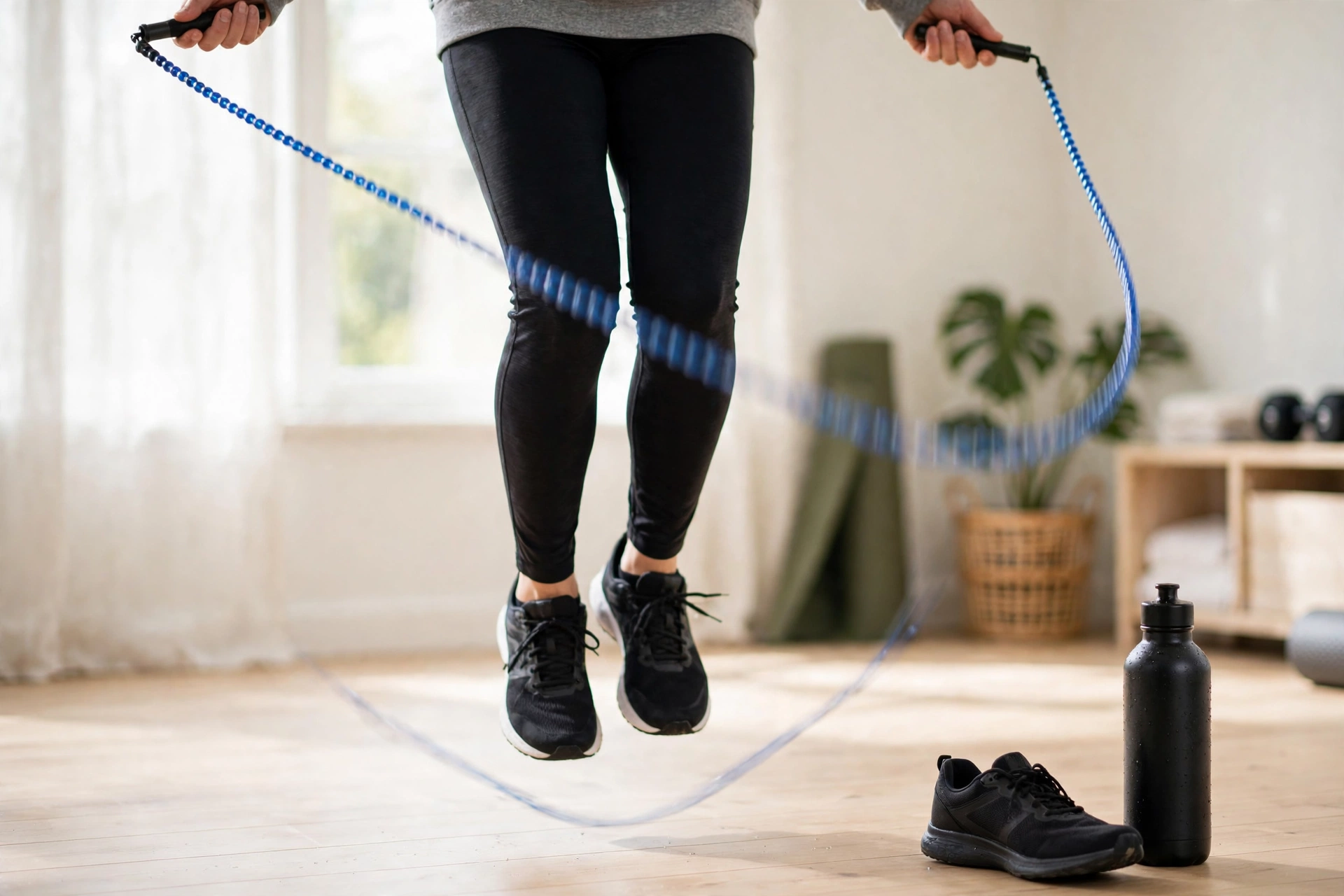 How many calories does jump rope burn?
Calorie burn depends mainly on your body weight, how fast you skip, and how much you rest. A 70 kg person skipping at a moderate pace burns roughly 200–300 calories in 15 minutes. Heavier people burn more, lighter people less, and faster skipping burns more.
For a 70 kg person skipping at a steady, moderate pace:
- 10 minutes: roughly 130–200 calories
- 15 minutes: roughly 200–300 calories
- 20 minutes: roughly 270–400 calories
- 30 minutes: roughly 400–600 calories
These are estimates, not exact figures — your real burn depends on your weight, speed, skill and rest breaks. To see how skipping fits your daily calorie needs, use our BMR and TDEE calculator to find your maintenance calories, then check our exercise calorie calculator.
Weight loss comes from a calorie deficit over weeks, not one workout. Skipping helps, but what you eat matters just as much: a 15-minute session burns the calories in a small snack.
Why jump rope works so well for weight loss
Skipping is efficient because it asks a lot of your body at once. Your legs drive every jump, your arms keep the rope turning, and your core stays braced. That whole-body effort is why the calorie burn per minute beats walking or easy cycling.
It also builds fitness that supports weight loss:
- Coordination and balance: timing jumps to the rope trains your brain and body to work together.
- Calf and leg strength: every jump is a small plyometric push from your calves, ankles and feet.
- Bone density: the gentle impact of landing helps keep bones strong as we age.
- Heart fitness: regular skipping improves cardiovascular endurance, so everyday activity feels easier.
It also fits real life: skip in a garden, a garage or a gym corner, and even 10 minutes counts.
How to start jump rope: the first week
If you have never skipped before, do not try to jump continuously for 10 minutes on day one. Start with short intervals and let your calves and coordination catch up:
- Warm up 3–5 minutes. Walk in place, march, circle your ankles and raise your calves.
- Skip 30 seconds, rest 30 seconds. Repeat 6–8 times. That is only 3–4 minutes of actual skipping.
- Cool down 3–5 minutes. Walk slowly, then stretch your calves, thighs and shoulders.
Your calves will probably feel sore for a day or two after the first sessions — that is normal. Rest a day between sessions in the first week, and add one or two extra intervals each session as the soreness fades.
Set the rope length before you start. Stand on the middle of the rope with one foot; the handles should reach your armpits. Too long trips you up; too short forces high jumps.
 Good form: jump low, stay relaxed
- Jump just high enough for the rope to pass. A centimetre or two is enough.
- Land softly on the balls of your feet. Keep your knees slightly bent.
- Keep your elbows low and close to your body. Turn the rope with small wrist movements, not big arm swings.
- Stay tall and look ahead. Avoid hunching over or staring at your feet.
- Breathe steadily. Match your breathing to a comfortable rhythm rather than holding your breath.
Wear supportive sports shoes with good cushioning, and skip on a forgiving surface — a wooden floor, a rubber gym mat, or a smooth outdoor court. Avoid concrete at first: it increases the impact on your knees and ankles.
Choosing the right jump rope
Any basic rope works for a beginner. A lightweight PVC or beaded rope is a good first choice: it turns easily and is cheap. Save weighted ropes until your form is solid.
Look for comfortable handles that do not slip in sweaty hands, and a rope you can adjust to your height. Avoid thin speed ropes at first — they punish every mistimed jump.
A simple 4-week beginner plan
This plan builds you from short intervals to 15 minutes of steady skipping, three days a week.
Week 1: learn the rhythm
Skip 30 seconds, rest 30 seconds, repeat 6–8 times (3–4 minutes of skipping). Focus on form, not speed.
Week 2: longer intervals
Skip 45 seconds, rest 30 seconds, repeat 8 times (about 6 minutes of skipping). You should feel more coordinated now.
Week 3: one-minute rounds
Skip 60 seconds, rest 30 seconds, repeat 8 times (8 minutes of skipping). Try a slightly faster pace in the last two rounds.
Week 4: steady skipping
Skip 90 seconds, rest 30 seconds, repeat 8 times — or try 2 minutes of steady skipping with 30-second rests (10–12 minutes of skipping).
After week 4, keep adding a minute or two per week until you reach 15–20 minutes per session. If you want a lower-impact day between sessions, our guide to walking for weight loss is a good companion workout.
Common mistakes beginners make
- Jumping too high. Big jumps tire you out fast and hurt your knees. Stay low.
- Using your arms instead of your wrists. Wide arm circles waste energy and slow the rope.
- Starting too fast. Going all-out on day one leads to sore calves and quitting. Build up gradually.
- Skipping on concrete. Hard surfaces increase impact and injury risk. Choose a mat or wooden floor.
- Holding your breath. Tense breathing makes you tire quickly. Breathe in a steady rhythm.
- Skipping every day at first. Your calves and ankles need recovery days, especially in the first weeks.
Who should be careful with jump rope?
Jump rope is high impact, so it is not right for everyone. People with knee, ankle or joint problems should start gently, keep sessions short, and choose a forgiving surface — or pick a lower-impact option. If you have a heart condition, high blood pressure, osteoporosis, or you are pregnant, check with your doctor first.
Stop and rest if you feel sharp pain in a joint, dizziness, or chest discomfort, and seek medical advice if it persists. Sore calves are normal when you start; sharp joint pain is not. A gentler workout you actually do beats an intense one you abandon after a week.
Key takeaways
- A 70 kg person burns roughly 200–300 calories in 15 minutes of moderate skipping.
- Start with 30 seconds skipping and 30 seconds rest; build up over 4 weeks.
- Jump low, land on the balls of your feet, and turn the rope with your wrists.
- Use good shoes and a forgiving surface — avoid concrete at first.
- Skipping builds coordination, leg strength, bone density and heart fitness.
- People with joint problems should start gently or choose a lower-impact option.
Frequently asked questions
How many calories does jump rope burn in 10 minutes?
A 70 kg person burns roughly 130–200 calories in 10 minutes of moderate skipping. Heavier people burn more and lighter people burn less, and the number rises if you skip faster or take fewer rests. Use our exercise calculator to estimate your own burn based on your weight and session length.
Is jump rope good for losing belly fat?
Jump rope burns calories and improves fitness, which helps with overall fat loss, but no exercise targets belly fat specifically. Fat loss happens across the whole body when you keep a calorie deficit over weeks. Skipping plus sensible eating is a strong combination for losing weight, including around the waist.
How long should a beginner skip each day?
Begin with 3–4 minutes of actual skipping in short intervals, three days a week, with rest days in between. Add a minute or two each week until you reach 15–20 minutes per session. Short, regular sessions beat one exhausting session followed by a week off.
Is jump rope bad for your knees?
Jump rope can be hard on the knees if your form is poor or you skip on concrete, but with good form it is usually fine for healthy knees. Jump low, land softly on the balls of your feet, wear cushioned shoes and use a forgiving surface. If you already have knee problems, start very gently or choose a lower-impact exercise and ask your doctor first.
What is the best jump rope for beginners?
A lightweight PVC or beaded rope with comfortable, non-slip handles is the best first rope. It turns at a forgiving speed, you can feel where it is, and it is inexpensive. Make sure it is adjustable so you can set it to your height, and save weighted or speed ropes until your form is solid.
Can I jump rope every day?
Most people do best skipping three to five days a week, not every day, especially at the start. Your calves, ankles and knees need recovery time, and rest days prevent overuse soreness. Once you are comfortable, you can skip more often, but keep at least one or two lighter or rest days each week.






Comments (0)
No comments yet. Be the first to share your thoughts!
Leave a comment