
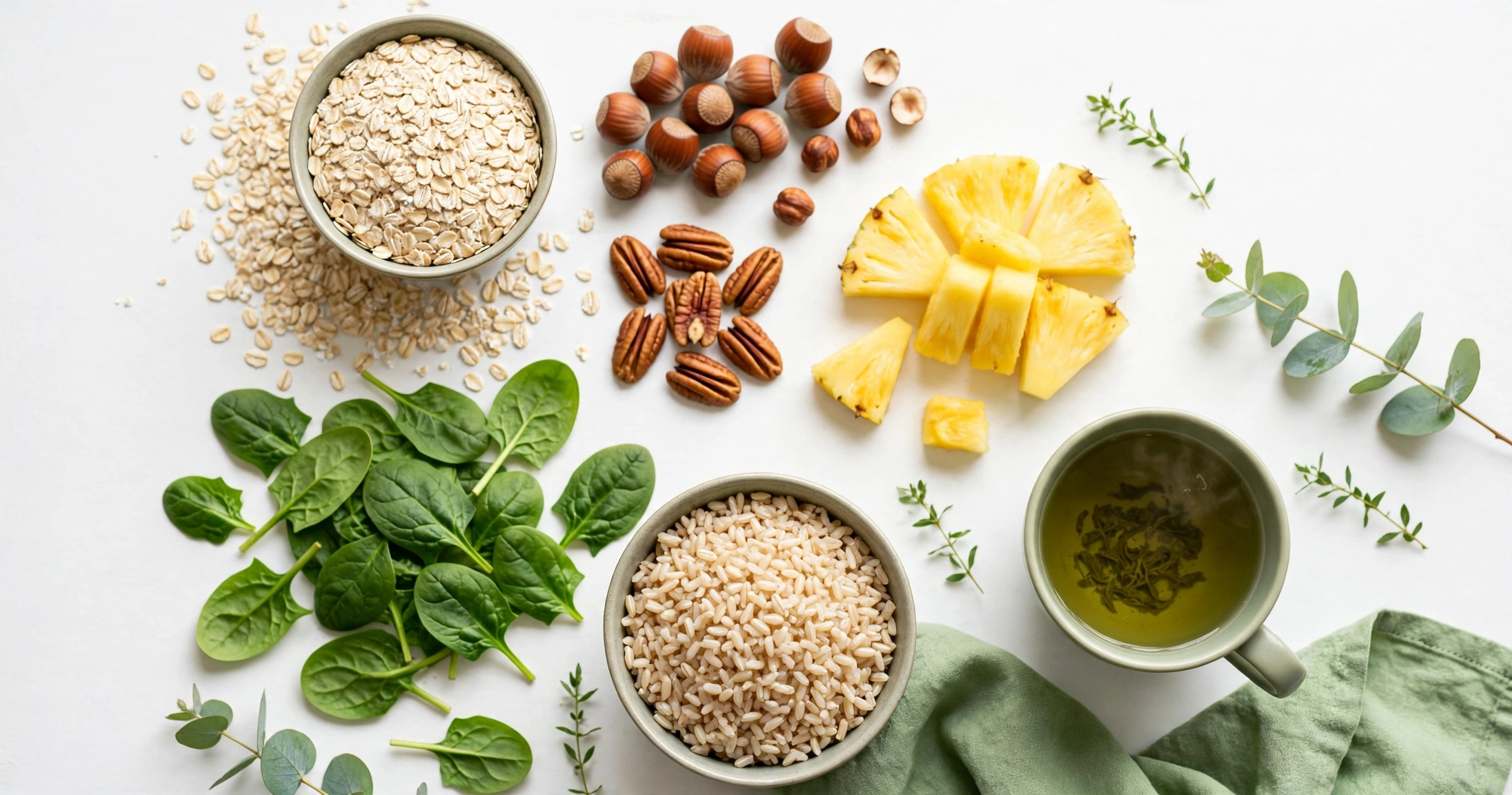
Short answer: Manganese is a trace mineral your body needs in small amounts for healthy bones, metabolism, and antioxidant defence. Most people get enough from whole grains, nuts, legumes, leafy greens, and tea. Deficiency is rare, and excess almost never comes from food — it comes from supplements or contaminated water.
 What manganese does in your body
Manganese is one of those minerals you rarely think about, but your body uses it every day. It works as a helper — called a cofactor — for enzymes that drive important chemical reactions, from building bone to turning food into energy.
Here are the main jobs manganese supports:
- Bone formation: Manganese helps build the cartilage and bone matrix that give bones their structure, and it works alongside calcium, vitamin D, and other nutrients to keep bones strong.
- Metabolism: It helps enzymes break down carbohydrates, amino acids, and cholesterol, so your body can turn food into energy and building blocks.
- Antioxidant defence: Manganese is a key part of superoxide dismutase (MnSOD), an enzyme inside your cells that neutralises harmful free radicals and protects cells from damage.
- Wound healing: Manganese supports collagen production, the protein that helps skin and tissue repair after a cut or injury.
- Brain and nerve function: It helps make neurotransmitters, the chemical messengers your brain uses to send signals, and supports normal nervous system function.
- Blood sugar handling: Manganese plays a role in enzymes involved in glucose metabolism, helping the body process blood sugar normally.
Your body cannot make manganese, so you must get it from food — but you need only a few milligrams a day, and it is found in many everyday plant foods. Check your overall diet with the Nutrition tool or track what you eat with the Calorie Tracker.
Signs of manganese deficiency
True manganese deficiency is rare in healthy people who eat a varied diet, because the mineral is widespread in plant foods. Most cases in research have involved very restricted diets, or people fed entirely through intravenous nutrition without manganese added.
The signs are easy to miss because they overlap with other problems. Watch for:
- Weak or fragile bones: Poor bone formation and reduced bone density have been linked to very low manganese, since the mineral helps build bone matrix.
- Slow wound healing: Cuts and scrapes that take longer than usual to heal can be a sign, because manganese supports collagen production.
- Skin rash or changes: A scaly rash and changes in skin pigmentation have been reported in severe deficiency.
- Impaired glucose tolerance: The body may handle blood sugar less well when manganese is very low.
- Slow growth in children: In children, severe deficiency has been linked to poor growth and bone development.
- Low mood and tiredness: Feeling low or tired can accompany many deficiencies, so it is not a specific sign on its own.
None of these signs alone proves a deficiency. If you have several, or you eat a very restricted diet, talk to your doctor before taking any supplement — a blood test and a review of your diet are the right way to find out what is going on.
Best food sources of manganese
Food is the best and safest source of manganese, and you do not need large portions — a cup of cooked oats, a handful of hazelnuts, and a cup of tea together cover a large share of your daily needs.
 The richest manganese foods
- Whole grains: Oats, brown rice, whole wheat bread, and quinoa are among the best sources, and they add up across the day.
- Nuts: Hazelnuts and pecans are particularly rich, and almonds and walnuts are good sources too — a small handful makes an easy snack.
- Legumes: Chickpeas, lentils, and soybeans offer manganese together with fibre, protein, and iron.
- Leafy greens: Spinach and kale add manganese along with folate, vitamin K, and other nutrients.
- Tea: Black and green tea are surprisingly good sources — a cup or two a day contributes meaningfully.
- Pineapple: Fresh pineapple is one of the richest fruits for manganese, and it adds natural sweetness to breakfast or snacks.
- Sweet potatoes: A baked sweet potato adds manganese along with vitamin A and fibre.
- Blueberries and raspberries: Berries add smaller amounts that still count toward your daily total.
An easy manganese-rich day
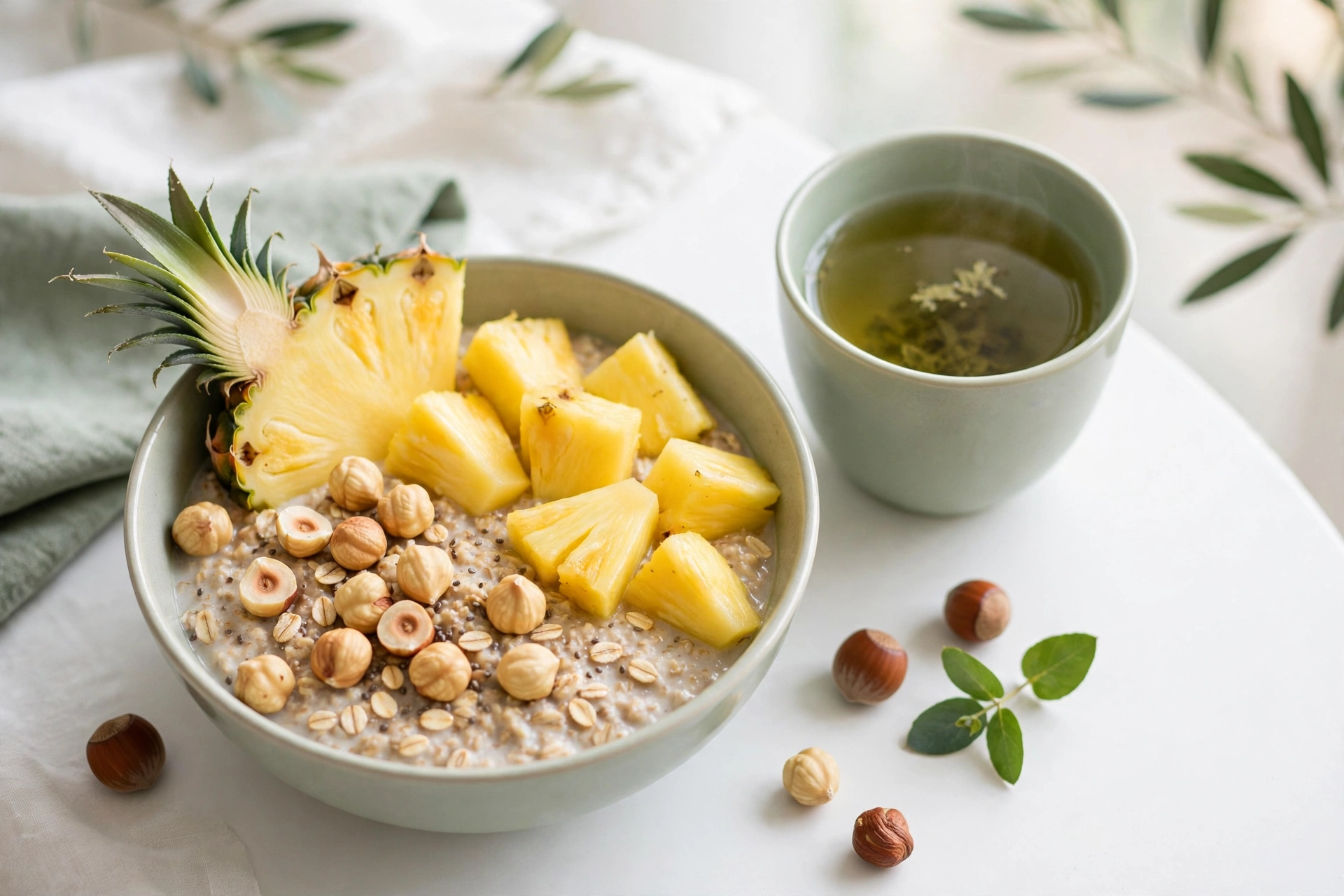
A day like this covers manganese naturally: oatmeal topped with hazelnuts and fresh pineapple for breakfast, a lentil soup with wholegrain bread for lunch, a cup of tea with a small handful of pecans as a snack, and a brown rice stir-fry with spinach and chickpeas for dinner.
For a related mineral, see our guide to magnesium benefits, deficiency, and best food sources — magnesium works alongside manganese in bone health and metabolism.
How much manganese do you need each day?
Adults need only a few milligrams a day. As a general guide, the widely published adequate intake is about 2.3 mg a day for adult men and about 1.8 mg a day for adult women. A varied diet with whole grains, nuts, and vegetables usually covers this easily.
Children need less, and their needs rise with age. There is no need to count milligrams precisely — if your meals regularly include whole grains, legumes, nuts, and leafy greens, you are almost certainly covered.
Can you get too much manganese?
It is very hard to get too much manganese from food alone. The body absorbs it slowly from food, and normal portions are naturally limited. Excess manganese is mainly a concern from high-dose supplements, contaminated well water, or long-term occupational exposure, not from a normal diet.
At very high levels over a long time, manganese can affect the nervous system, causing tremor and movement problems. Health authorities generally set an upper intake level of around 11 mg a day for adults — far above what food provides. The message is simple: enjoy manganese-rich foods freely, but do not take high-dose manganese supplements without medical advice.
Do you need a manganese supplement?
For most people, the answer is no. Food covers manganese needs easily, and supplements are only useful when a deficiency has been confirmed — for example by a blood test, or when a doctor has found a medical reason.
Most standard multivitamins already contain a small amount of manganese, and that is enough for anyone who needs a top-up. Be careful if you already take several supplements, and tell your doctor or pharmacist about everything you take.
Our guide to copper benefits, deficiency, and best food sources covers another trace mineral that works alongside manganese in antioxidant defence.
Key takeaways
- Manganese is a trace mineral needed in small amounts for bone formation, metabolism, antioxidant defence, and wound healing.
- Deficiency is rare in healthy people eating a varied diet — watch for weak bones, slow healing, skin changes, and poor glucose tolerance.
- Adults need only a few milligrams a day — about 2.3 mg for men and 1.8 mg for women as a general guide.
- The best sources are whole grains, hazelnuts and pecans, legumes, leafy greens, tea, and pineapple.
- Excess almost never comes from food — supplements and contaminated water are the real risks, so avoid high-dose supplements.
- Food is the safe route — a varied plant-rich diet covers manganese easily.
Frequently asked questions
1. What is manganese good for?
Manganese helps your body build strong bones, turn food into energy, defend cells against damage, and heal wounds. It is a trace mineral, so you only need a few milligrams each day, and most of it comes from ordinary plant foods like oats, nuts, and leafy greens.
2. What are the signs of manganese deficiency?
The most common signs are weak or fragile bones, slow wound healing, skin rash or changes, and poor blood sugar handling. Slow growth in children can also be a sign in severe cases. Because these signs overlap with other conditions, a blood test and a doctor's advice are the right way to confirm a deficiency.
3. Which foods are highest in manganese?
Whole grains like oats and brown rice, hazelnuts and pecans, chickpeas and lentils, spinach and kale, tea, and pineapple are the richest sources. A cup of cooked oats, a handful of nuts, and a cup of tea together cover a large share of your daily needs.
4. How much manganese do I need per day?
As a general guide, adults need about 2.3 mg a day for men and about 1.8 mg a day for women. You do not need to count milligrams — a varied diet with whole grains, legumes, nuts, and leafy greens usually covers this easily.
5. Can I get too much manganese from food?
It is very unlikely. The body absorbs manganese from food slowly, and normal food portions are naturally limited. Excess manganese problems almost always come from high-dose supplements or contaminated water, not from a normal diet. Eating manganese-rich foods in ordinary amounts is safe.
6. Do I need a manganese supplement?
Most people do not. Food provides enough manganese, and supplements are only needed when a deficiency has been confirmed by a doctor, for example with a blood test or a medical condition. A standard multivitamin already contains a small amount, which is enough for anyone who needs a top-up.




Comments (0)
No comments yet. Be the first to share your thoughts!
Leave a comment