
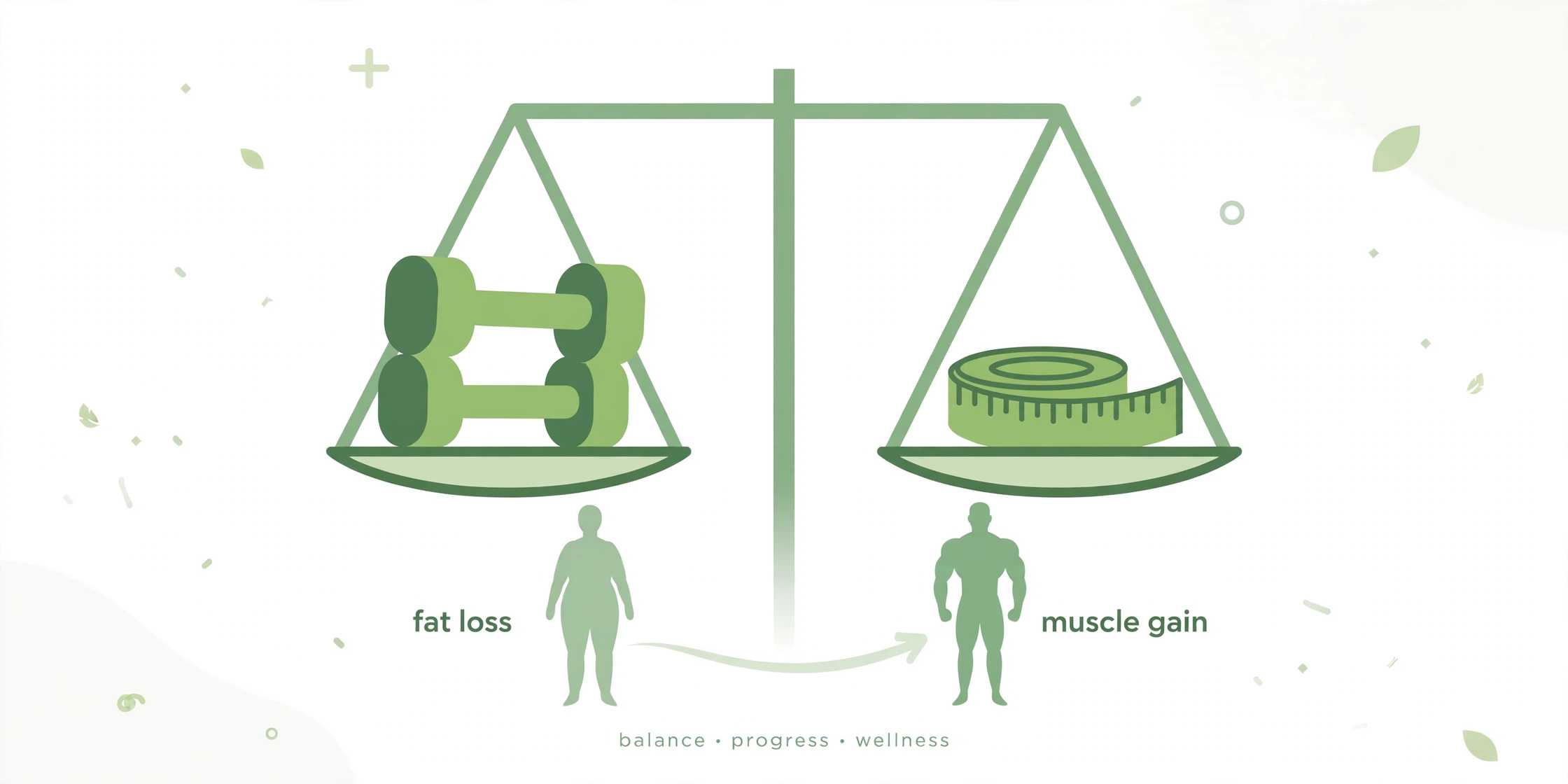
The short answer: Body recomposition is losing fat and building muscle at the same time. It works best for beginners, people returning to training after a break, and those carrying more body fat — using resistance training, roughly 1.6–2.2 grams of protein per kilogram of body weight daily, and a small calorie deficit, not an aggressive cut.
For decades, fitness advice split the world in two: "bulk" for muscle, "cut" for fat, never both. Body recomposition breaks that rule — you train and eat so your body sheds fat while adding lean muscle at once. Slower than dedicated phases, but for many the most sustainable path to getting stronger and leaner.
Note: this article is educational, not medical advice. Talk to a doctor or qualified professional before changing how you eat and train — especially with a health condition, medication, or pregnancy.
 Key Takeaways
- Losing fat and gaining muscle simultaneously — the scale often barely moves while your body changes.
- Best for beginners, returners after a break, and those with higher body fat; slower for advanced lifters.
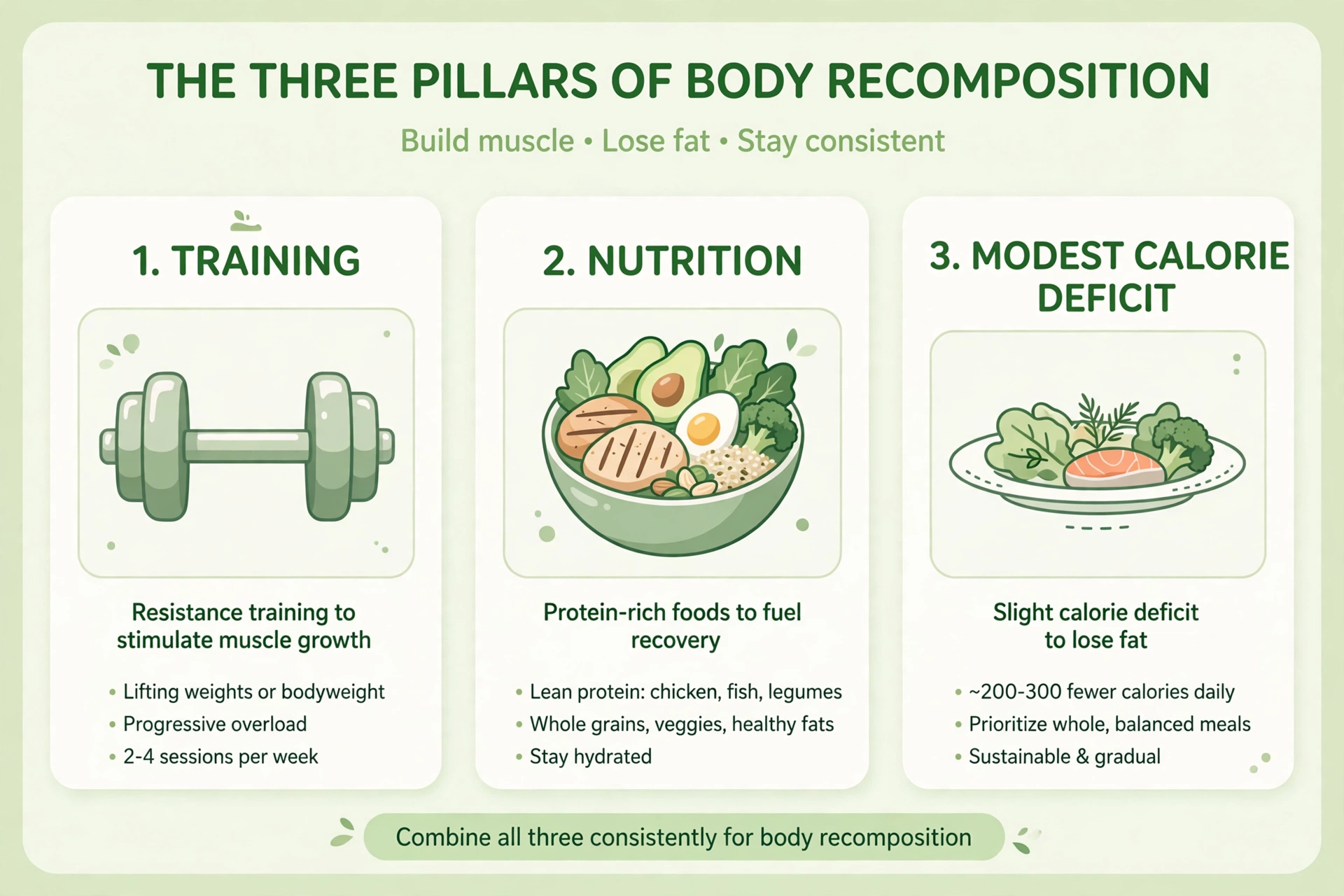
- Four pillars: progressive resistance training 3–5x/week, 1.6–2.2 g protein per kg body weight daily, a small calorie deficit (~10–15%) or maintenance, and 7–9 hours of sleep.
- Track progress with measurements, photos, and strength gains — not just the bathroom scale.
- Visible changes typically take 8–16+ weeks of consistent effort — patience is part of the program.
What Is Body Recomposition? Why the Scale Lies
Body recomposition means changing your body's composition — less fat, more muscle — without necessarily changing total weight much. Muscle is denser than fat, so a kilo of muscle takes up less space than a kilo of fat; two people at the same weight can look completely different. The scale is a poor scoreboard for this goal.
During a successful recomposition, the scale may move only a few kilos over months — or not at all — while your waist shrinks and clothes fit differently. Judging by the scale alone is the most common reason people quit too early.
Instead, track three things: measurements (waist, hips, chest, arms, thighs — monthly), progress photos (same lighting, same poses, every 2–4 weeks), and strength (are your lifts going up?). A shrinking waist plus climbing lifts means recomposition is happening — whatever the scale says.
Who Body Recomposition Works Best For
It works best for three groups:
- Beginners. New lifters gain muscle fast — "newbie gains" are real — and that fresh stimulus lets muscle grow even in a small deficit.
- Detrained lifters. Muscle memory helps former trainees regain size fast while losing fat simultaneously.
- People with higher body fat. More stored energy means the body can fuel muscle building while drawing on fat reserves.
If you are already lean and advanced, it still works but slowly — dedicated bulk/cut phases are usually more efficient for maximum muscle.
The Four Pillars of Body Recomposition
Nail these four and the process nearly runs itself; miss one and progress stalls.
1. Resistance training 3–5 times per week
Muscle grows in response to a challenge, so lifting weights — or serious bodyweight training — is non-negotiable. Hit each major muscle group at least twice weekly with compound lifts: squats, hinges (like deadlifts), presses, and rows or pull-ups. New to lifting? Our beginner strength guide covers the first four weeks.
The key is progressive overload: gradually more over time — a little more weight, an extra rep, better form. Without it, muscles have no reason to grow.
2. Enough protein: roughly 1.6–2.2 g per kg of body weight
Protein is muscle's raw material. Sports-nutrition research most often cites about 1.6–2.2 grams per kilogram of body weight daily (~0.7–1 g/lb) — for an 80 kg person, about 130–175 g. Individual needs vary; treat it as a target band, not a magic number.
Spread it over 3–5 meals (25–40 g each works well) from whole foods: eggs, chicken, fish, Greek yogurt, lentils, tofu, lean beef. See our protein for fat loss guide for more.
3. A small calorie deficit — or maintenance
Unlike a cut, keep the deficit modest — ~10–15% below maintenance, or simply eat at maintenance. An aggressive deficit (25–30%+) sabotages muscle building and tanks performance.
Find maintenance first with the BMR/TDEE calculator, then shave off 10–15% or hold steady. Keep it consistent for weeks; small and steady wins.
4. Sleep 7–9 hours and real recovery
Muscle is built in recovery, not in the gym. Aim for 7–9 hours of sleep — poor sleep raises hunger hormones and lowers performance. Take 1–2 full rest days weekly, manage stress, and stay generally active (daily steps and movement outside workouts — NEAT — add up quietly).
Body Recomposition Training Split: A Sample Week
This simple 4-day upper/lower split covers it all:
- Monday — Upper body: bench press or push-ups, rows, overhead press, pull-ups or lat pulldowns, curls + triceps
- Tuesday — Lower body: squats, Romanian deadlifts, lunges, leg curls, calves
- Wednesday — Rest (a walk is fine)
- Thursday — Upper: repeat Monday; add a rep or a little weight
- Friday — Lower: repeat Tuesday, progressing gradually
- Saturday — Optional: light cardio, mobility, or a fun outing
- Sunday — Rest
Prefer three days? Go full-body Monday/Wednesday/Friday. Add 1–3 short cardio sessions weekly — but never instead of lifting (see cardio vs. strength training for fat loss).
 Common Body Recomposition Mistakes
- A deficit that is too big. Too little food kills energy, strength, and growth. Keep it to ~10–15% or maintenance.
- Skipping protein. Hard training on low protein is like building a house without bricks — hit 1.6–2.2 g/kg daily.
- No progressive overload. Same weights and reps for months means no growth stimulus — track lifts and beat them gradually.
- Program hopping. Switching routines every two weeks blocks adaptation. Commit to one program for 8–12 weeks.
- The cardio-only approach. Running burns calories but barely tells muscle to stay, let alone grow. Lift first; add cardio around it.
How Long Until You See Results?
Longer than crash diets promise, faster than you might fear. Most consistent beginners see visible changes — leaner waist, fuller muscles, better definition — within 8–16 weeks, with real transformation over 6–12 months. The mirror and tape measure tell the story; the scale does not. Judge in months, not days.
The Bottom Line
Body recomposition is real and one of the most sustainable ways to change how you look and perform: lift progressively 3–5 times weekly, eat 1.6–2.2 g of protein per kilo daily, keep any calorie deficit small, and sleep well. It rewards beginners most, demands patience, and beats the endless bulk-cut yo-yo. Start where you are, stay consistent, and let measurements — not the scale — judge your success.
Frequently Asked Questions
Is body recomposition really possible, or is it a myth?
It is real and well documented: beginners, detrained lifters, and people with higher body fat routinely gain muscle while losing fat when combining resistance training with enough protein. Just slower and less dramatic than dedicated bulk/cut phases.
How long does body recomposition take?
Allow 8–16+ weeks of consistent training before changes are obvious to others, and 6–12 months for a real transformation. Beginners often progress faster early on. Training history, starting body fat, protein, and consistency set the timeline — there is no universal schedule.
Should I do cardio during body recomposition?
Yes, in moderation: 1–3 short cardio sessions weekly support fat loss, recovery, and heart health without hurting muscle gains. But cardio should supplement lifting, never replace it — lifting signals your body to build and keep muscle.
Do I need supplements for body recomposition?
None is required. Whole foods, enough protein, progressive training, sleep, and patience do the heavy lifting. Creatine monohydrate has strong evidence for strength and muscle gain but is optional — check with a doctor first, as always.
Can advanced lifters do body recomposition?
They can, but far slower than beginners, as growth potential shrinks with experience. Advanced lifters usually do better with dedicated muscle-building and fat-loss phases — recomposition suits staying lean while slowly improving.
How much protein do I really need for recomposition?
The widely cited target is 1.6–2.2 g per kilo daily, spread across meals. Needs vary — bigger, harder-training, or older lifters often do better at the upper end. If your intake is far below that, even reaching the lower half of the range helps noticeably.






Comments (0)
No comments yet. Be the first to share your thoughts!
Leave a comment