

You can build strength and burn fat at home with bodyweight exercises like squats, push-ups, lunges, planks, and glute bridges. Train 3–4 days per week, progress by adding reps, sets, or harder variations, and support your training with enough protein and 7–9 hours of sleep to recover and grow stronger.
No gym membership. No dumbbells. No excuses needed — because home workouts with no equipment genuinely work. Your body is the most versatile piece of training equipment you own, and with the right exercises and progression, bodyweight training builds real strength, burns fat, and improves fitness.
Whether you are a complete beginner, traveling, or just prefer training in your living room, this guide gives you the best no-equipment exercises, how to structure them, and a 4-week plan to get started.

Why Bodyweight Training Actually Works
Muscles do not know whether resistance comes from a barbell or your body — they only know tension. Research shows bodyweight training increases strength and muscle size comparably to weighted training for beginners, especially when exercises are progressed over time. Additional benefits of training at home:
- Zero barrier to entry — no commute, no fees, no waiting for equipment.
- Joint-friendly — bodyweight moves are generally easier on joints than heavy lifting.
- Full-body coordination — compound moves like squats and push-ups train balance and core stability alongside strength.
- Easy to stay consistent — and consistency beats perfection every time.
The 8 Best No-Equipment Exercises
These eight moves cover every major muscle group. Master these and you have a complete program.
1. Squats — legs and glutes
Stand with feet shoulder-width apart, push your hips back, and bend your knees until thighs are parallel to the floor. Keep your chest up and knees tracking over your toes. Make it harder: slow the descent to 4 seconds, add a 2-second pause at the bottom, or try single-leg assisted squats.
2. Push-ups — chest, shoulders, triceps
Hands under shoulders, body in a straight line from head to heels. Lower your chest to the floor, then press up. Too hard? Start on your knees or with hands on a raised surface. Too easy? Elevate your feet or slow the tempo.
3. Lunges — legs, glutes, balance
Step forward, lower until both knees are bent at 90 degrees, then push back up. Alternate legs. Keep your torso upright. Progression: walking lunges, reverse lunges (easier on knees), or Bulgarian split squats with your back foot on a chair.
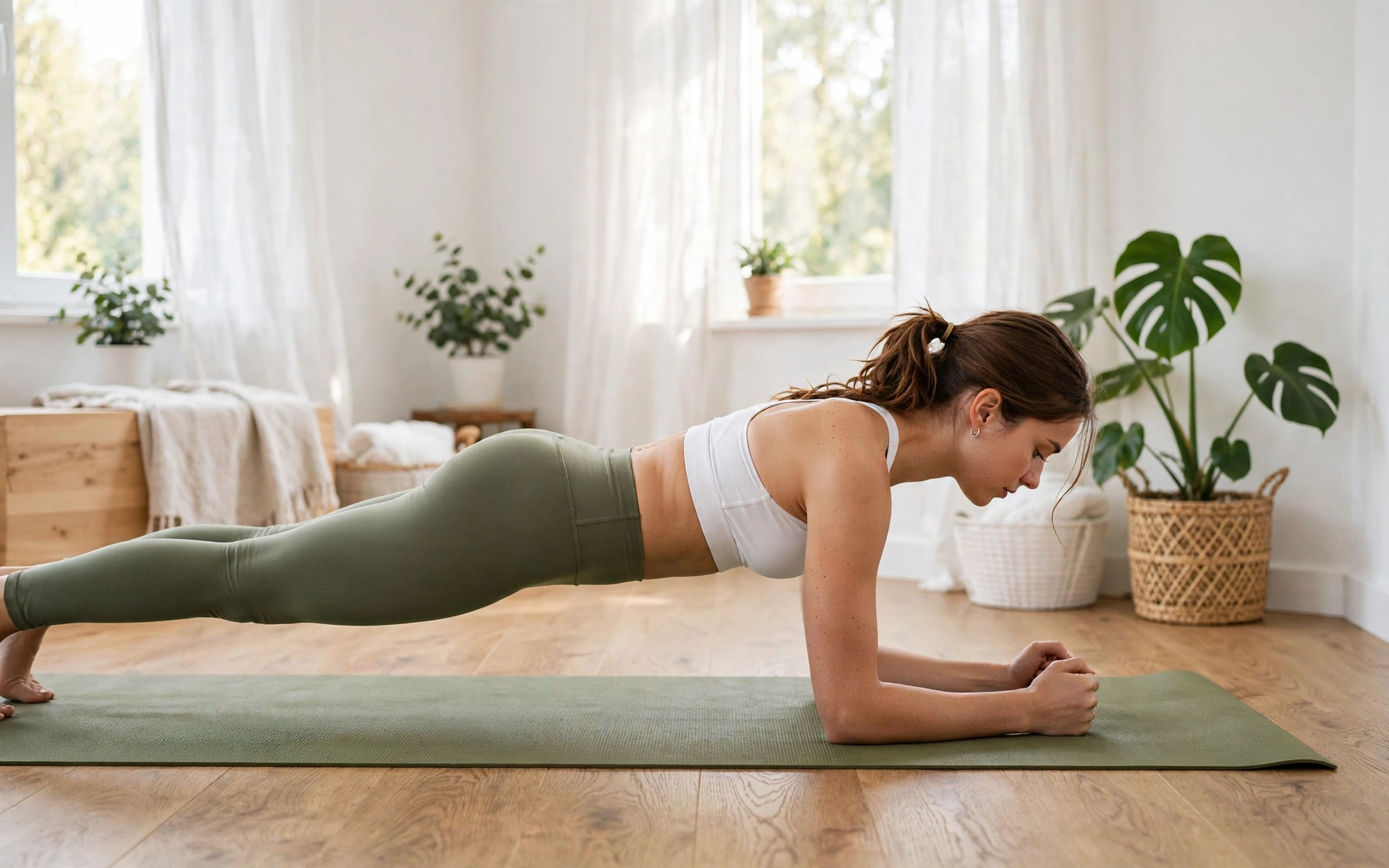
4. Plank — core
Forearms on the floor, body straight, abs and glutes tight. Hold 20–60 seconds. Quality beats duration — stop when your hips sag. Progress with side planks and plank shoulder taps.
5. Glute bridges — glutes and lower back
Lie on your back, knees bent, feet flat. Drive through your heels to lift your hips, squeeze your glutes at the top, and lower slowly. Essential for counteracting long hours of sitting. Progress to single-leg bridges.
6. Mountain climbers — cardio and core
From a plank position, drive your knees toward your chest alternately at a quick pace. Great for raising your heart rate and burning calories in short workouts.
7. Superman — back and posture
Lie face down, extend your arms forward, and lift your arms, chest, and legs off the floor. Hold 2 seconds. Strengthens the lower back muscles that weaken from desk work.
8. Tricep dips — arms
Hands on the edge of a sturdy chair behind you, legs extended. Lower your body by bending your elbows, then press back up. A simple, effective arm builder using household furniture.
How to Structure a Home Workout
A balanced 25–35 minute session looks like this:
- Warm-up (5 min): marching in place, arm circles, leg swings, and 10 easy bodyweight squats.
- Main circuit (20 min): pick 5–6 exercises, perform each for 40 seconds with 20 seconds rest, and repeat the circuit 2–3 times.
- Finisher (3 min): 30 seconds of mountain climbers, 30 seconds rest, repeated 3 times.
- Cool-down (5 min): gentle stretching for the muscles you trained.
Log each session in an exercise log so you can see your reps and rounds improving week to week — visible progress is the best motivation.
Your 4-Week Beginner Plan
Train 3 days per week (e.g., Monday, Wednesday, Friday) with rest days between. If you are brand new to lifting of any kind, our beginner's strength training guide pairs perfectly with this plan.
- Week 1: 2 rounds of each circuit, 30 seconds work / 30 seconds rest. Learn the movements.
- Week 2: 2 rounds, 40 seconds work / 20 seconds rest.
- Week 3: 3 rounds, 40 seconds work / 20 seconds rest.
- Week 4: 3 rounds, 45 seconds work / 15 seconds rest, and try one harder variation per exercise.
After week 4, keep progressing: more rounds, harder variations, or slower tempos. Progression is what turns "just moving" into "getting stronger."
Fueling Your Home Workouts
Training is only half the equation. Support your sessions with:
- Protein: about 1.6–2.2 g per kg of body weight daily to repair and build muscle.
- Pre-workout meal: carbs + a little protein 1–2 hours before (oatmeal with fruit, or toast with peanut butter).
- Hydration: water before, during, and after — even bodyweight sessions cause meaningful fluid loss.
- Sleep: muscles recover while you sleep; 7–9 hours matters as much as the workout itself.
Wondering how strength training compares with cardio for your goals? Read our breakdown of cardio vs. strength training for fat loss.
Common Home Workout Mistakes
- Skipping the warm-up — cold muscles and stiff joints invite injury, even without weights.
- Rushing reps — slow, controlled movements build more muscle than fast, sloppy ones.
- Never progressing — doing the same easy routine for months maintains fitness but does not build it. Add reps, rounds, or harder variations regularly.
- Training through sharp pain — muscle burn is fine; joint pain is a stop signal.
- All exercise, no nutrition plan — check your daily calorie needs with a BMR/TDEE calculator so your eating supports your training goal.
Key Takeaways
- Bodyweight exercises build real strength — muscles respond to tension, not equipment.
- Master 8 moves: squats, push-ups, lunges, plank, glute bridges, mountain climbers, superman, tricep dips.
- Train 3–4 days/week, 25–35 minutes, and progress reps, rounds, or difficulty every week.
- Fuel with enough protein, hydrate, and sleep 7–9 hours for recovery.
- Track your sessions to see progress and stay motivated.
Comments (0)
No comments yet. Be the first to share your thoughts!
Leave a comment