
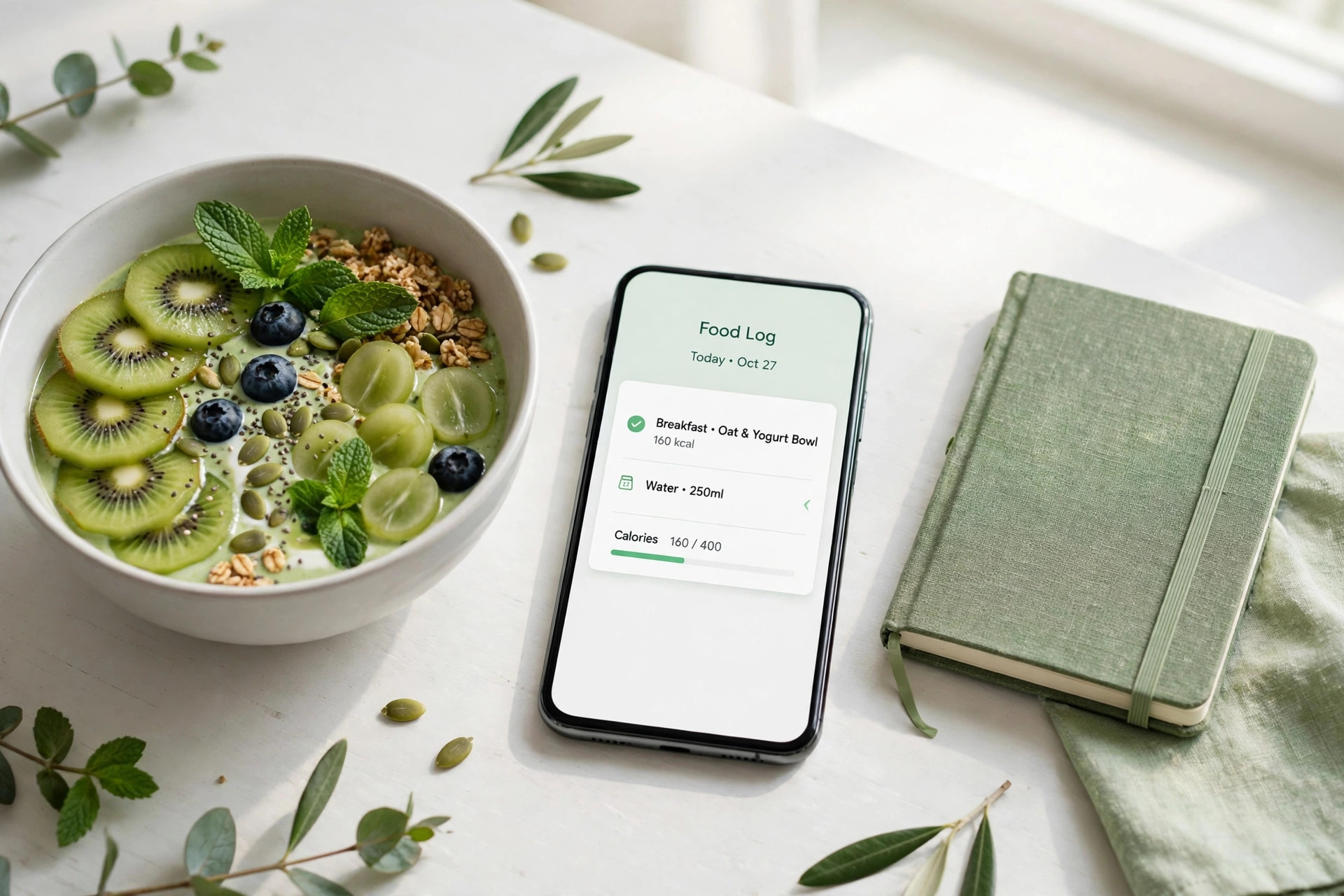
A good calorie log helps you lose weight when it is simple, honest, and consistent. Log soon after eating, estimate portions reasonably instead of chasing perfection, and review your week for patterns rather than judging single days. That takes about five minutes a day.

Key takeaways
- A calorie log works through awareness and consistency, not perfection.
- Log meals soon after eating, in one place, every day.
- Estimate portions with your hand and common household measures when you have no scale.
- Review your log weekly for patterns — late snacks, big portions, or skipped meals — not for guilt.
- Take planned breaks from logging when it starts to feel stressful or obsessive.
What a calorie log is — and what it is not
A calorie log is a simple record of what you eat and drink, with a rough calorie estimate per item. It is not a test to pass or fail, nor a punishment after a big meal. Its job is to show your habits clearly: snack frequency, real portion sizes, and where most calories come from.
Many people quit logging because they try to make every entry exact. That is unnecessary: regular, approximate tracking beats occasional perfect tracking, because the benefit comes from paying attention. If your log is roughly right most days, it is useful.
What to log in your calories log
Keep entries short. For each meal or snack, record:
- What you ate — the food or drink, in plain words ("2 slices toast with butter, 1 egg").
- How much — a portion estimate (1 cup rice, 1 palm-sized piece of chicken, 1 tablespoon oil).
- When — the time, or simply breakfast, lunch, dinner, or snack.
- Anything easy to forget — cooking oil, sauces, sugary drinks, and alcohol, which add calories without feeling like a meal.
You do not need to log every vitamin or nutrient gram, or exact brands. The NutriCounter calorie tracker is designed for exactly this kind of quick, plain-language entry.
What NOT to obsess over
- The exact calories in a homemade mixed dish — estimate the main ingredients and move on.
- A single day over your target — one day does not decide your weight trend.
- Calories burned through exercise — keep food logging and activity separate to avoid "earning" extra food.
- Weighing every herb, spice, or splash of milk in your tea.
A simple 5-minute daily routine for your calorie log
Logging works best as a small habit attached to meals, not a chore saved for bedtime:
- Log as you go (2 minutes). After each meal, take 30 seconds to note what you ate. Logging straight away is far more accurate than reconstructing the day at night.
- Pre-log when you can (1 minute). If you know what lunch will be, enter it in the morning. You can adjust it later if plans change.
- Capture the extras (1 minute). Once a day, quickly add drinks, sauces, and snacks — the items most often forgotten.
- Close the day (1 minute). Glance at your total, note whether the day felt balanced, and stop. Do not re-analyse every item.
Missed a meal? Log what you remember and move on — a gap is no reason to abandon the day or week.
Estimating portions without a scale
You do not need a kitchen scale. Your hand and kitchenware give surprisingly consistent estimates:
- Protein: a palm-sized piece of meat, fish, or tofu is roughly one serving.
- Cooked rice or pasta: a fist-sized portion is roughly one cup.
- Vegetables: two open handfuls make a generous serving.
- Cheese: a thumb-sized piece is roughly one ounce.
- Fats and oils: a thumb tip is about one teaspoon; a full tablespoon is about three teaspoons.
When a food has a label, use it. For packaged snacks, log the whole pack if you ate it all. For more on why small logging errors happen, see our guide to calorie counting mistakes to avoid.
Restaurant meals and homemade food
Restaurant meals are the hardest part of any calories log, because portions are larger and ingredients hidden:
- Search for a similar dish in your tracker app rather than the exact restaurant item.
- Estimate the plate in parts: protein, starch, vegetables, and visible fat or sauce, then add them up.
- Assume a restaurant main course is larger than a home portion — if in doubt, log the bigger estimate and move on.
- Log drinks and bread served before the meal; they count too.
For homemade food, log the main ingredients rather than calculating the whole recipe precisely. If you cook lentil soup for four, log roughly one quarter of the main ingredients: lentils, oil, onion, and tomato. The same approach works for stews, curries, and baked dishes.
Reviewing your log weekly: look for patterns, not guilt
Once a week, spend ten minutes on the whole week, not one day. Ask yourself:
- On which days was my total highest, and what was different about those days?
- Is there a snack or drink that appears almost every day?
- Am I skipping meals and then eating much more later?
- Are my portions growing without me noticing?
Then pick ONE small change for the next week — a smaller evening snack, water instead of a sugary drink at lunch, or a vegetable added to dinner. One change is enough. If your goal is a moderate deficit, read our guide on what a calorie deficit is and how to approach it safely before setting a daily target.
When to stop logging and take a break
Logging is a tool to put down when it stops helping. Consider a planned break if:
- You feel anxious, guilty, or out of control around food because of the log.
- You are skipping social meals to avoid logging them.
- You feel you cannot eat anything without recording it first.
- Logging has become a daily source of stress rather than clarity.
A break does not mean giving up. Many people log for a few weeks, take a week off while keeping the habits they learned, and return later if they want. If food tracking is affecting your wellbeing, talk to a doctor or a registered dietitian. This article is general information only, not medical advice.
Frequently Asked Questions
How long does it take to keep a calorie log each day?
About five minutes once the habit is set: seconds per meal as you eat, plus a quick end-of-day check. Pre-logging planned meals makes it faster. If it takes much longer, simplify your entries.
Do I need to weigh all my food for a calorie log?
No. A scale can help at first for foods you eat often, but hand-based estimates are enough for a useful log. Weighing everything is a common reason people quit — use a scale briefly to calibrate your eye, then switch to estimates.
What should I do if I forget to log a meal?
Log what you remember, even roughly, and continue with your next meal. Do not skip the whole day because one meal is missing — an incomplete log is still far more useful than no log.
Can I lose weight without logging calories every day?
Yes. Logging is one method, not a requirement. Consistent meal patterns, more vegetables and protein, and fewer sugary drinks also work without daily tracking. Logging is most useful when you want clear data on why your weight is not changing.
Is it normal for my weight to fluctuate while I keep a calorie log?
Yes. Daily changes mostly reflect water, food volume, and digestion, not fat gain or loss. Judge progress by the trend over two to four weeks, not one weigh-in. If the trend is flat for weeks, review portions and daily extras first.




Comments (0)
No comments yet. Be the first to share your thoughts!
Leave a comment