
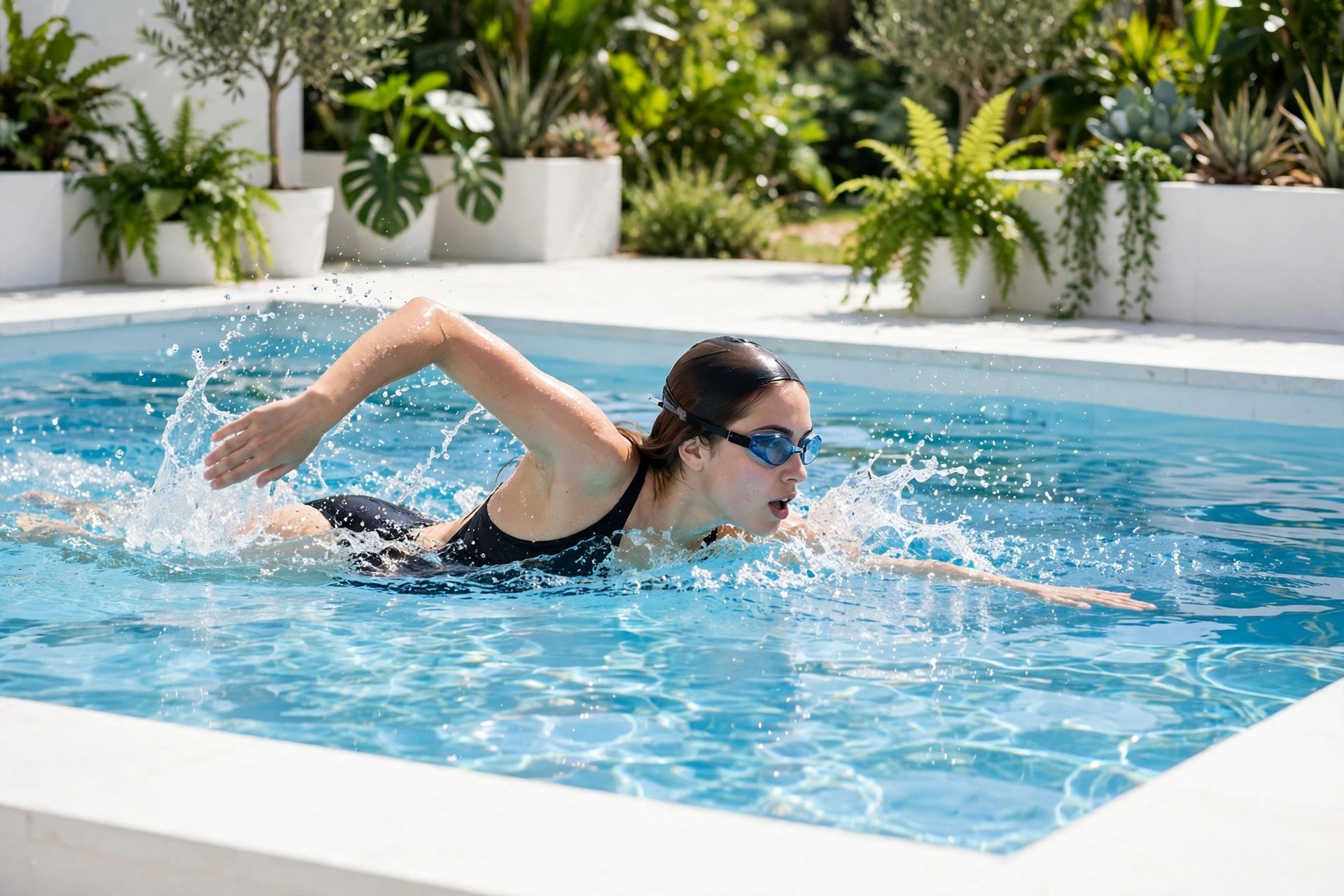
Swimming burns roughly 200–400 calories in 30 minutes for an average adult, depending on your weight, stroke, and effort — and it does it without pounding your knees or ankles. Yes, swimming can absolutely help you lose weight, as long as you swim regularly and pair it with sensible eating, because it works your whole body while keeping your joints safe.
 Why Swimming Works So Well for Weight Loss
Swimming is one of the few exercises that trains your arms, legs, core, and back at the same time. Water is about 800 times denser than air, so every movement meets resistance — and that resistance is what builds muscle and burns calories. At the same time, the water supports your body weight, so your joints carry almost no impact.
That combination makes swimming especially useful if you:
- Are carrying extra weight and find running or jumping uncomfortable.
- Have sore knees, ankles, or a sensitive lower back.
- Get bored easily — swimming offers four strokes, drills, and intervals to mix things up.
- Want a full-body workout that also improves your breathing and posture.
How Many Calories Does Swimming Burn?
The honest answer is: it depends. Your weight, your speed, your stroke, and how efficiently you swim all change the number. A heavier person burns more calories doing the same activity, and a fast, continuous swim burns far more than a slow, stop-start one. The figures below are estimates for an average adult (around 70 kg / 155 lbs) swimming for 30 minutes at a steady, moderate-to-vigorous effort. Treat them as a guide, not a guarantee.
Calories burned per 30 minutes by stroke (estimates)
- Freestyle (moderate pace): about 250–350 calories. The fastest and most efficient stroke, and the best choice for steady calorie burning.
- Freestyle (fast, vigorous pace): about 350–450 calories. Intervals and sprints push this higher still.
- Breaststroke (moderate pace): about 200–300 calories. Slower than freestyle but easier to sustain, and great for beginners.
- Backstroke: about 200–300 calories. A good option if you want to rest your face and shoulders while keeping moving.
- Butterfly: about 350–450 calories. The most demanding stroke — powerful, but hard to sustain for long if you are new to it.
- Easy swimming / water walking: about 120–200 calories. Still useful, especially on recovery days or while you are learning.
To put that in context: a 30-minute moderate freestyle session burns roughly the same as a brisk 30-minute jog, but with far less impact on your joints. You can check your own numbers with our exercise log, which estimates the calories burned for your weight and workout, and use our BMR and TDEE calculator to see how many calories you need per day to lose weight at a healthy pace.
Swimming vs Running and Walking: Which Is Better for Your Joints?
Running is excellent for burning calories, but every step sends impact through your knees, hips, and ankles. Walking is gentler but burns fewer calories per minute. Swimming sits in the sweet spot: high calorie burn with almost zero impact.
- Swimming: full-body, low impact, 200–400 calories per 30 minutes. Ideal for heavier bodies, sore joints, and hot weather.
- Running: high calorie burn, but high impact. Great if your joints are healthy and you enjoy it.
- Walking: the gentlest option and easy to do daily. Burns fewer calories per minute, so it needs more time to match a swim.
You do not have to choose just one. Many people lose weight fastest by combining two or three: swim twice a week, walk daily, and add a short run or strength session when you feel ready. If you already enjoy walking, our guide to calories burned walking, running, cycling, and swimming compares all four side by side.
Your Beginner 4-Week Swimming Plan for Weight Loss
You do not need to swim for an hour on day one. Two or three sessions a week, building gradually, is enough to start losing weight — consistency beats heroic single sessions. Rest at the wall whenever you need to; the goal is total time moving, not non-stop swimming.
Week 1 — Get comfortable (2 sessions, 20 minutes each)
- 5 minutes easy warm-up: gentle freestyle or breaststroke, slow and relaxed.
- 8 x 1 length freestyle or breaststroke, resting 30–60 seconds between lengths.
- 5 minutes easy cool-down: slow swimming or walking in the shallow end.
Week 2 — Build your base (2–3 sessions, 25 minutes each)
- 5 minutes warm-up.
- 6 x 2 lengths with 30 seconds rest between sets.
- 5 minutes cool-down plus gentle stretching at the pool edge.
Week 3 — Add intervals (3 sessions, 30 minutes each)
- 5 minutes warm-up.
- 4 x 3 lengths at a moderate pace, resting 45 seconds between sets, then 4 x 1 fast length with 30 seconds rest.
- 5 minutes cool-down.
Week 4 — Swim longer, rest less (3 sessions, 30–35 minutes each)
- 5 minutes warm-up.
- 10–12 lengths continuous or in sets of 4, with short rests only as needed.
- Try one session with a kickboard: 4 x 1 length legs-only to strengthen your legs and core.
- 5 minutes cool-down.
After four weeks, aim for 3 sessions of 30–45 minutes per week. That is roughly 150 minutes of moderate activity — the amount most health guidelines recommend — and it is enough to see real weight-loss progress when your eating supports it.
Technique Tips That Help You Burn More Calories
Good technique does not just look better — it lets you swim further, faster, and with less wasted effort, which means more calories burned in the same session.
- Keep your body flat. Look at the bottom of the pool, not forward. Your hips and legs should ride near the surface, not drag behind you.
- Breathe on a rhythm. In freestyle, breathe every two or three strokes. Exhale slowly underwater so you are ready to inhale quickly when you turn your head.
- Kick from your hips, not your knees. Small, fast flutter kicks keep your legs up and your body streamlined.
- Reach and pull. Enter the water fingertips first, then pull the water back past your hip. A long stroke beats a frantic one.
- Use the wall. A neat push-off and a short glide after every turn saves energy and keeps your pace steady.
If you can, ask a lifeguard or coach to watch one length and point out the single biggest fix. One small correction — head position, usually — can transform your swimming in a single session.
 Common Mistakes That Slow Your Progress
- Swimming too slowly to raise your heart rate. A gentle float burns far fewer calories than a purposeful swim. Aim for a pace where talking is possible but not easy.
- Resting too long at the wall. Short rests are fine; long chats between lengths are not training.
- Only swimming one stroke. Mixing freestyle and breaststroke uses different muscles and keeps the workout balanced.
- Eating back everything you burned. Swimming makes many people hungry. A protein-rich snack and a glass of water after your swim beats a large sugary treat.
- Skipping the plan. Random swims help, but a simple plan — like the 4-week one above — keeps you progressing week after week.
What to Eat Around Your Swims
You do not need a special diet to lose weight with swimming, but a few habits help. Eat a light snack 1–2 hours before swimming — a banana, toast with peanut butter, or yoghurt — rather than swimming on a full stomach or completely empty. After swimming, drink water first (thirst often feels like hunger), then eat a meal with protein and some carbohydrates to help your muscles recover. Keep your overall calories in a modest deficit: our BMR and TDEE calculator shows you a safe daily target. For low-impact exercise ideas on your rest days, see our guide to low-impact workouts for beginners.
Key Takeaways
- Swimming burns roughly 200–400 calories in 30 minutes, depending on stroke, speed, and body weight.
- Freestyle and butterfly burn the most; breaststroke and backstroke are easier to sustain as a beginner.
- It burns about as many calories as jogging but with almost no impact on your joints.
- Start with 2–3 sessions a week and follow a simple 4-week plan — consistency matters more than speed.
- Pair swimming with a modest calorie deficit to actually lose weight; exercise alone rarely does it.
Frequently Asked Questions
How many calories do you burn swimming for 30 minutes?
An average adult burns roughly 200–400 calories in 30 minutes of swimming, depending on stroke, speed, and body weight. Moderate freestyle burns about 250–350 calories, breaststroke and backstroke about 200–300, and vigorous butterfly up to 350–450. Faster swimming and a heavier body weight both increase the number.
Is swimming good for weight loss?
Yes, swimming is very good for weight loss when done regularly. It burns a similar number of calories to jogging while working your whole body and protecting your joints. Like any exercise, it works best combined with a modest calorie deficit — swimming alone will not cancel out overeating.
How often should I swim to lose weight?
Aim for 3 sessions of 30–45 minutes per week, which adds up to about 150 minutes of moderate exercise. Beginners can start with 2 sessions of 20 minutes and build up over four weeks. Daily walking on top of your swim days helps too, and rest days let your muscles recover.
Which swimming stroke burns the most calories?
Butterfly burns the most calories per minute, followed closely by fast freestyle, but both are hard to sustain for long. For most people trying to lose weight, moderate freestyle is the best choice: it burns a lot of calories and you can keep it up for 30 minutes or more. Mixing strokes across a session also works well.
Can I lose belly fat by swimming?
Swimming can help you lose overall body fat, including belly fat, but no exercise targets one area alone. Fat loss comes from a sustained calorie deficit, and swimming helps create that deficit while building muscle across your core, arms, and legs. Combine regular swimming with balanced eating and you will gradually see your waistline shrink.



Comments (0)
No comments yet. Be the first to share your thoughts!
Leave a comment