
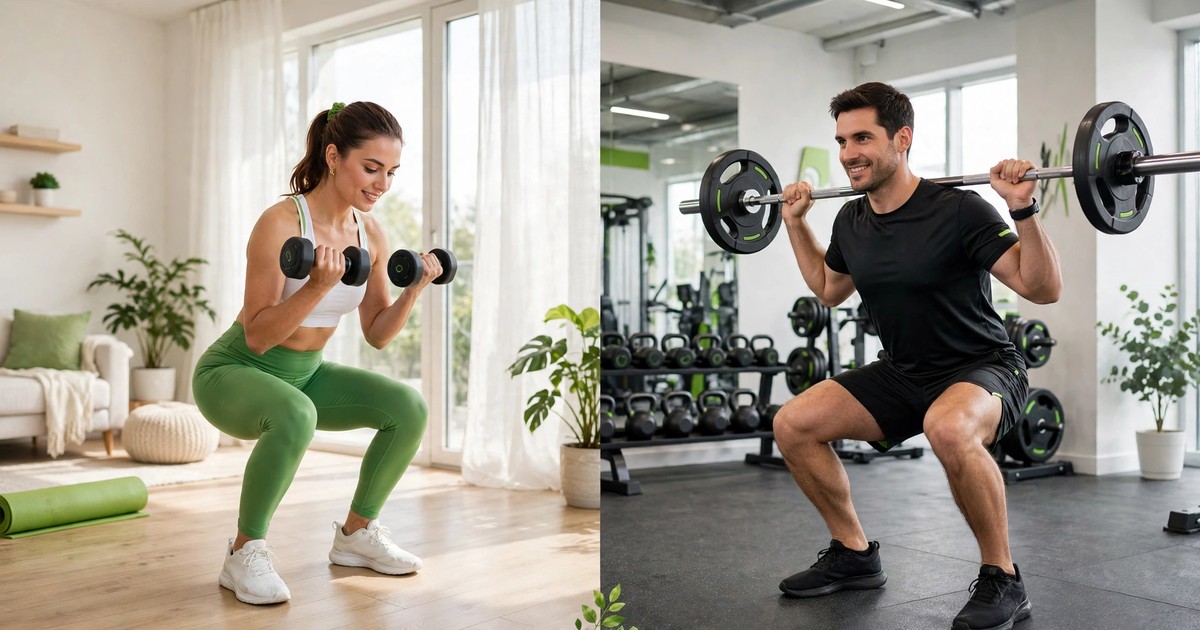
Direct answer: Neither option is universally better. The best choice is the one you will use consistently for months, not weeks. Home training wins on cost, convenience and privacy, while a gym wins on heavy equipment, variety and atmosphere. If you enjoy it and can progress gradually, either setting can build real strength — and you can even combine both.
If you are starting strength training, one of the first decisions is where to train. A gym membership sounds serious and motivating, while a home setup sounds cheaper and easier to fit into a busy day. Both can work. What matters most is not the location, but whether you train regularly, use good form, and make the exercises gradually harder over time.
Strength training simply means working your muscles against resistance so they get stronger. That resistance can come from dumbbells, barbells, machines, resistance bands, or your own body weight. The science of getting stronger is the same everywhere: challenge a muscle, let it recover, then challenge it a little more. The setting only changes how easy each part of that process is for you.
Home vs Gym: The Honest Comparison
There is no winner for everyone. The right answer depends on your budget, your space, your personality, and how much equipment your goals need. Here is how the two options compare, factor by factor.
Cost
Home training is usually far cheaper. A no equipment strength training workout costs nothing at all, and a basic home setup — a pair of adjustable dumbbells and a resistance band — is often less than a few months of gym fees. A gym membership is a monthly cost that continues whether you go or not, so it only pays off if you actually use it several times a week.
Equipment
Gyms win clearly here. They offer heavy barbells, squat racks, cable machines, and a wide range of weights that are hard to match at home. That matters most if your goal is lifting very heavy weights. For general strength, fitness, and muscle tone, however, bodyweight exercises plus a few dumbbells or bands are genuinely enough for a long time.
Motivation and atmosphere
Some people train harder around other people. The gym atmosphere, set opening hours, and the feeling of having "gone somewhere to train" help them stay consistent. Others find gyms intimidating or distracting, and train far more reliably in the privacy of their own home, where nobody is watching and there is no waiting for equipment. Be honest about which type you are — the best program is the one you actually do.
Progression
Getting stronger requires progression: more repetitions, harder exercise variations, slower movements, or heavier weights. Gyms make this easy because you can add small weight plates whenever you are ready. At home, progression takes a little more creativity — moving from knee push-ups to full push-ups, from bodyweight squats to single-leg squats, or adding a weighted backpack. It is entirely possible, but you need a plan, not just random workouts. If you want help tracking your sessions, try the NutriCounter exercise tool to log what you did and watch your progress over time.
Space and time
Home training wins on time. There is no commute, no parking, and no waiting for machines, so a 30-minute session really takes 30 minutes. You only need a space about the size of a yoga mat for most bodyweight work. A gym needs travel time, but gives you space and equipment you may not have at home — a real advantage if you live in a small flat or share your home with others.
No Equipment Strength Training Workout: What It Looks Like
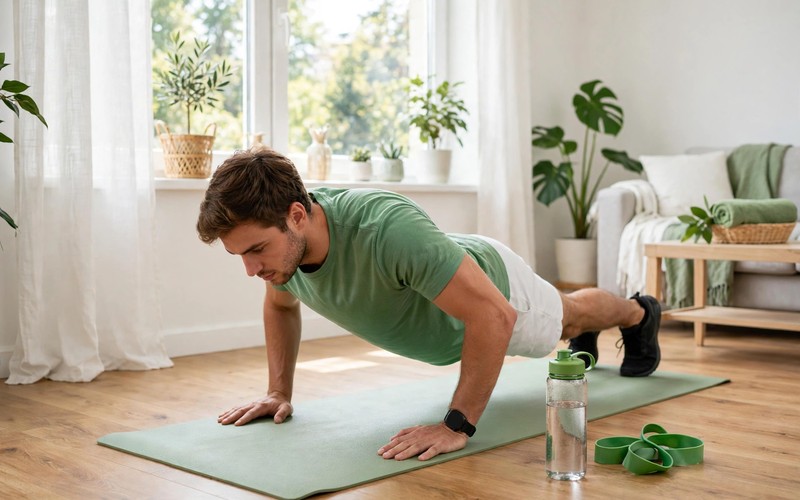
A no equipment strength training workout uses your body weight as resistance. Done well, it builds real strength, especially for beginners and intermediate trainers. A simple full-body session could look like this:
- Warm-up (5 minutes): marching in place, arm circles, and gentle leg swings.
- Squats: 3 sets of 10–15 repetitions, keeping your chest up and knees tracking over your toes.
- Push-ups: 3 sets of as many good-form repetitions as you can — start on your knees if needed.
- Glute bridges: 3 sets of 15 repetitions, squeezing your glutes at the top.
- Plank: 3 holds of 20–40 seconds, keeping your body in a straight line.
- Reverse lunges: 2–3 sets of 8–10 per leg, holding a chair for balance if needed.
- Cool-down (5 minutes): gentle stretching for the legs, hips, chest, and shoulders.
Train this kind of session two to three times per week, with at least one rest day between sessions. When it gets easy, make it harder before adding anything new: slow the lowering phase down, add repetitions, or move to a harder variation. That steady progression is what builds strength, not fancy equipment.
How to Progress at Home When Weights Run Out
Every home trainer eventually asks: what happens when bodyweight gets too easy? You have more options than you think. First, change the leverage — elevate your feet for push-ups, or try single-leg squats and split squats. Second, slow down — taking three to five seconds to lower yourself makes the same exercise much harder. Third, add load cheaply — a backpack filled with books works well for squats and lunges. Finally, add a few tools only when you need them: adjustable dumbbells and a pull-up bar cover most goals for years.
Strength training also works best alongside sensible eating. Knowing roughly how many calories your body uses helps you decide whether to eat a little more to build muscle or a little less to lose fat. The NutriCounter BMR and TDEE calculator gives you that starting estimate in a minute, so your training and your nutrition pull in the same direction.
How to Choose: A Simple Decision Guide
Ask yourself these questions, and the answer usually becomes clear:
- Will you actually go? If the gym is far away or you hate the atmosphere, home training will win on consistency alone.
- What is your goal? General strength and fitness work brilliantly at home; very heavy lifting is easier at a gym.
- What is your budget? If money is tight, start at home — it costs nothing to begin.
- Do you need coaching? Beginners who want hands-on form checks may benefit from a gym floor, a class, or a few sessions with a trainer.
- Can you combine both? Many people do home workouts on weekdays and a gym session on weekends — you do not have to pick just one.
If you are completely new to strength work, our beginner guide is a good starting point: Strength Training for Beginners: Your First 4 Weeks. And if you want ready-made no-equipment sessions, see Home Workouts With No Equipment.
Key Takeaways
- Neither home nor gym training is universally better — consistency beats location.
- Home training wins on cost, time, and privacy; gyms win on heavy equipment and variety.
- A no equipment strength training workout builds real strength, especially for beginners.
- Progression is the key: harder variations, slower repetitions, and added load over time.
- Two to three sessions per week, with rest days between, is a solid starting point.
- You can combine both — home on busy days, gym when you want heavier weights.
Frequently Asked Questions
Can you build muscle at home without equipment?
Yes, especially as a beginner or intermediate trainer. Bodyweight exercises like squats, push-ups, lunges, and planks provide enough resistance to build strength and muscle when you progress them gradually. Advanced lifters chasing very heavy weights will eventually benefit from added equipment, but most people can train effectively at home for a long time.
Is the gym better than home workouts for weight loss?
Neither is automatically better for weight loss. Fat loss comes mainly from a sustained calorie deficit, with training helping to preserve muscle and burn extra energy. The better choice is whichever setting helps you train consistently, because a program you stick with beats a perfect program you abandon after two weeks.
How many days a week should I strength train?
Two to three full-body sessions per week is a good starting point for most people, with at least one rest day between sessions. Muscles need recovery time to repair and grow stronger, so more is not always better. If you train four or more days, split the work so each muscle group still gets rest days.
What equipment do I need to start training at home?
Nothing at all to begin with — your body weight is enough. When you are ready to progress, a resistance band and a pair of adjustable dumbbells are the most useful first purchases. A yoga mat adds comfort for floor work, and a sturdy chair helps with balance during lunges and step-ups.
How do I stay motivated training at home?
Set a fixed time, keep your workout space ready, and track your sessions so you can see progress. Short, scheduled sessions are easier to keep than long, vague ones. Training with a friend over a video call, following a written plan, or mixing home days with an occasional gym visit can all help motivation last beyond the first few weeks.



Comments (0)
No comments yet. Be the first to share your thoughts!
Leave a comment