
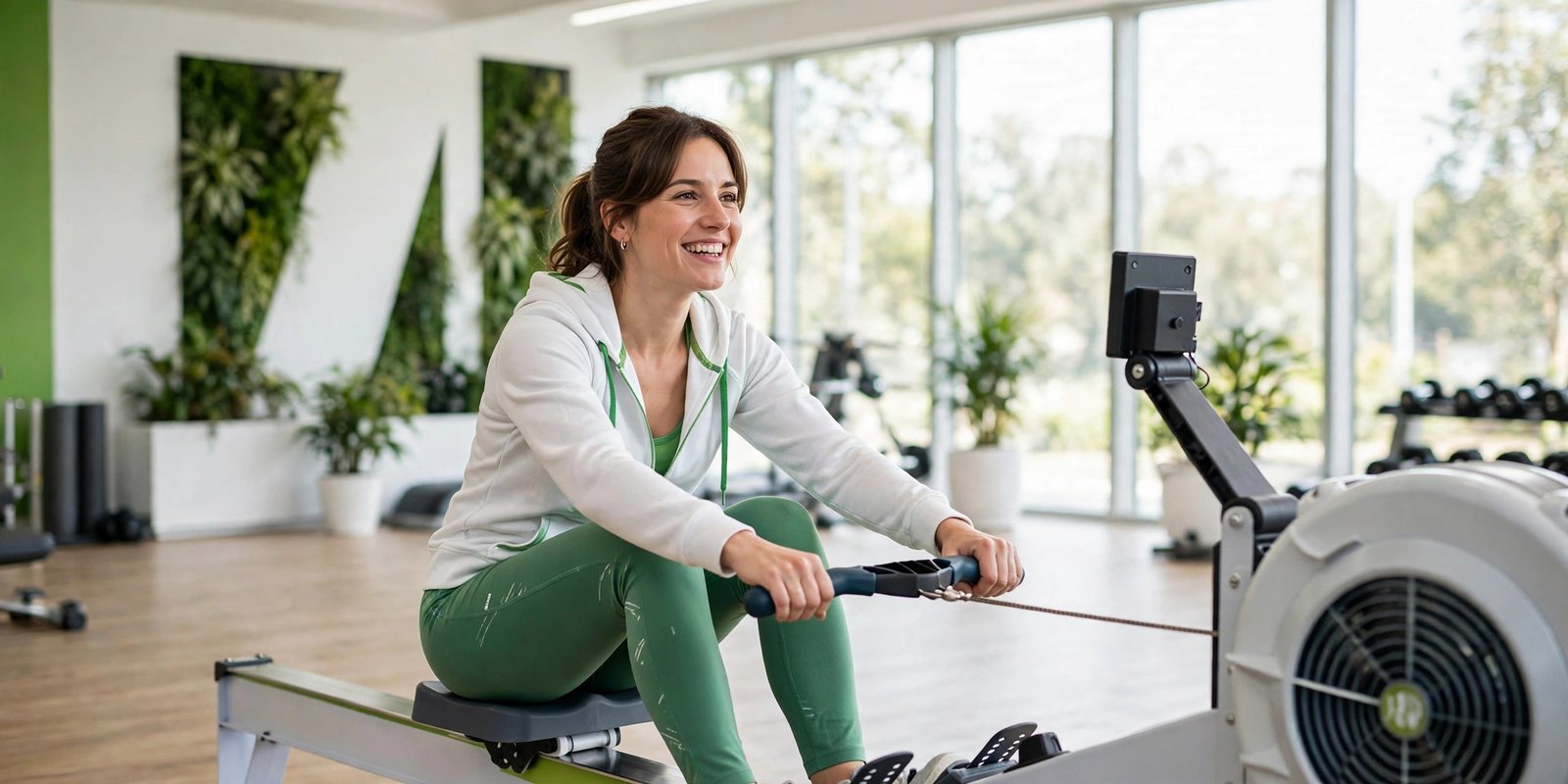
Yes, rowing works well for weight loss because it uses your legs, back, arms and core at once and burns a high number of calories for a low-impact exercise. A 70 kg person rowing at moderate effort typically burns roughly 400–600 calories per hour, though the exact number depends on weight, intensity and duration.
Rowing is an efficient way to lose weight without pounding your knees and hips. Unlike running, your feet never hit the ground. Unlike cycling, your upper body does real work too. Every stroke asks your legs to push, your core to stabilise, and your arms to pull.
It is also practical: a rowing machine takes up little space, works in any weather, and you can start slowly. This guide covers the calorie numbers, comparisons with walking, cycling and swimming, correct form, and a four-week plan.

Why Rowing Works So Well for Weight Loss
Weight loss comes down to a sustained calorie deficit — using more energy than you take in. Rowing burns a lot of energy, and because it uses so much muscle, it leaves you pleasantly tired rather than beaten up.
- Full-body workout. Coaches describe the stroke as roughly 60% legs, 30% core and back, and 10% arms.
- Low-impact. Your feet stay planted and your body glides on a rail, with no repeated jarring on your joints.
- Strength and fitness. Rowing strengthens legs, glutes, back, shoulders and core, and encourages better posture.
- Easy to scale. Row gently for 10 minutes or push hard for 30; damper, stroke rate and duration control the intensity.
- Time-efficient. A 20–30 minute row can feel like a much longer walk or easy cycle.
Rowing alone will not guarantee weight loss — food still matters most. But with sensible eating and regular movement, it reliably raises daily energy use. Try the BMR and TDEE calculator.
How Many Calories Does Rowing Burn?
There is no single exact number: burn depends on weight, intensity, technique and duration. Heavier people burn more doing the same activity, and a hard, fast row burns far more than a gentle one. Treat every figure as a broad estimate, not a promise.
A 70 kg person rowing at moderate effort typically burns roughly 400–600 calories per hour. At a light pace, that person might burn roughly 300–400 per hour. At a vigorous pace — breathing hard and struggling to talk — it could rise to roughly 600–800 per hour for a short period.
A lighter person, around 55–60 kg, will usually burn less at the same pace, while a heavier person, around 85–100 kg, will usually burn more. That is why calculators that ignore your weight can mislead.
- 10 minutes, easy: roughly 60–100 calories for most adults
- 20 minutes, moderate: roughly 130–200 calories
- 30 minutes, moderate: roughly 200–300 calories
- 30 minutes, vigorous: roughly 300–400 calories
Consistency matters most: three or four moderate sessions a week, repeated for months, beat one heroic hour followed by a week off. Track them with the exercise calorie calculator.
Does Rowing Burn Belly Fat?
No exercise burns fat from one specific area. Rowing burns calories across your whole body, and your body decides where fat comes off first. It can help create the deficit that leads to gradual fat loss everywhere, including around the waist. Combine it with a modest deficit and enough protein, and be patient.
Rowing vs Walking, Cycling and Swimming
All of these can work for weight loss. The best one is usually the one you enjoy enough to do regularly.
Rowing vs walking: Walking is gentler and excellent for daily movement, but burns fewer calories per hour. A brisk walk might burn roughly 200–300 calories per hour for a 70 kg person, compared with roughly 400–600 for moderate rowing.
Rowing vs cycling: Cycling is also low-impact and can burn a similar number of calories at a vigorous pace, especially on hills. Rowing has an edge for upper-body work — cycling trains mainly the legs.
Rowing vs swimming: Vigorous swimming can burn as many calories as vigorous rowing, or more. The difference is practical: swimming needs a pool, while a rowing machine is ready in seconds. See our calories burned walking, running, cycling and swimming guide and our swimming for weight loss guide.

Proper Rowing Form in 4 Steps
Good form matters more in rowing than in almost any other cardio exercise. Poor form wastes energy and strains your lower back. Think legs first, then body, then arms — and the reverse on the way back. Set the damper to 3–5; higher does not mean better, just heavier.
- The catch. Sit tall, knees bent, shins near vertical, arms straight, torso leaning slightly forward from the hips. Grip lightly.
- The drive. Push through your feet with your legs first, arms straight. Then lean back slightly and pull the handle to your lower ribs.
- The finish. Legs straight, torso leaning back slightly, handle close to your lower chest. Pause briefly.
- The recovery. Arms first, then hinge forward from the hips, then bend your knees and slide forward. Take about twice as long as the drive.
Keep your back straight, breathe naturally — exhale on the drive, inhale on the recovery — and aim for 24–28 strokes per minute. If your lower back hurts, stop and check you are driving with your legs.
A Beginner 4-Week Rowing Plan for Weight Loss
This plan assumes you are generally healthy and new to rowing. Warm up 3–5 minutes before each session and cool down 3–5 minutes after.
Week 1 — Learn the movement
Row 3 times, 12–15 minutes each, easy to moderate. Focus on form. Rest at least a day between sessions. You should be able to talk in short sentences.
Week 2 — Add a little time
Row 3 times, 18–20 minutes each, moderate. Try two minutes harder followed by two minutes easy, repeated three times.
Week 3 — Build to 25 minutes
Row 3–4 times, 22–25 minutes each, including one steady 25-minute session. You should notice better rhythm and less soreness.
Week 4 — Reach 30 minutes
Row 3–4 times, 25–30 minutes each, with one interval session: 5 rounds of 2 minutes moderately hard and 2 minutes easy. Then progress slowly — add 5 minutes every one or two weeks, or a fourth session, not both at once.
Common Mistakes to Avoid
- Pulling with your arms first. Your legs are far stronger; if your arms tire first, your order is wrong.
- Rounding your lower back. Keep your spine long and hinge from the hips.
- Rushing the recovery. Sliding forward too fast wastes energy and breaks your rhythm.
- Damper too high. Most experienced rowers train at 3–5; very high settings strain the back.
- Gripping too tightly. A relaxed grip keeps shoulders and forearms fresh.
- Too much too soon. First-week soreness is normal, but sharp pain is not. Build gradually.
Indoor Rower vs On-Water Rowing
An indoor rower is the simplest way to start: it is in most gyms, shows time, distance and calories, and you can train in any weather. On-water rowing adds fresh air and balance, and is often social — but needs water, a club, lessons and good weather. If weight loss is your main goal, start indoors.
Who Should Check With a Doctor First?
Talk to your doctor before starting if you have a heart condition, high blood pressure, back problems, joint problems limiting knee or hip bending, or if you are pregnant, recovering from surgery, or told to avoid strenuous exercise. Seek advice too for chest pain, dizziness, unusual breathlessness or sharp joint pain.
Key Takeaways
- Rowing is full-body and low-impact, burning roughly 400–600 calories per hour at moderate effort for a 70 kg person, as a broad estimate.
- Exact burn varies with weight, intensity, technique and duration — treat figures as ranges, not guarantees.
- Good form is legs, then body, then arms — and arms, body, legs on the recovery. Keep the damper at 3–5.
- Start with 3 sessions of 12–15 minutes a week and build to 25–30 minutes over four weeks.
- Rowing works best with sensible eating, daily walking and enough sleep — not as a replacement for them.
- Check with a doctor first if you have a heart condition, back problems, or anything affecting exercise safety.
Rowing will not change your weight overnight, but it is kind to your joints and easy to keep doing. Start gently and build the habit week by week.






Comments (0)
No comments yet. Be the first to share your thoughts!
Leave a comment