

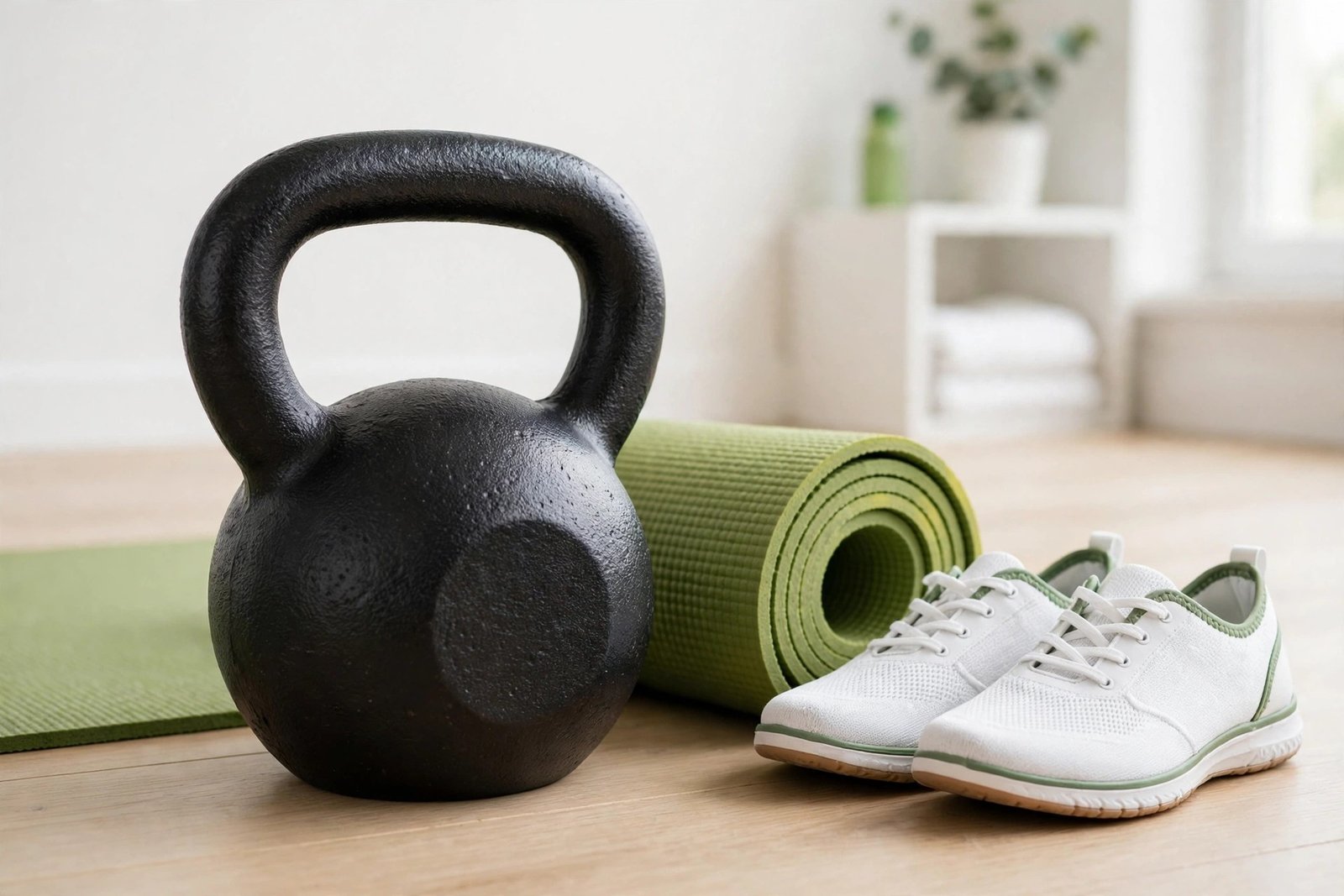
Kettlebell training for beginners is a simple way to build strength and fitness with one piece of equipment: a cannonball-shaped weight with a handle. A 20-minute session combines strength and cardio, working your legs, back, core, and grip at the same time. Start light, learn the hip hinge first, and you can train effectively at home with just one bell.
What is kettlebell training for beginners?
A kettlebell is a round weight, usually made of cast iron or steel, with a single handle on top. Unlike a dumbbell, most of the weight sits below the handle, so the bell swings and shifts as you move it. That shifting weight is what makes kettlebell training different — and so effective.
Most kettlebell exercises are full-body movements built around the hip hinge: you push your hips back, then drive them forward powerfully to move the bell. This pattern trains your glutes, hamstrings, back, and core together, the same muscles you use to lift a heavy box, pick up a child, or climb stairs. A single kettlebell can replace a whole rack of weights for a beginner, and it takes up almost no space.
Benefits of kettlebell training for beginners
Kettlebells are popular for a good reason — one tool delivers several kinds of fitness at once:
- Strength and cardio in one session: swings and squats raise your heart rate while building muscle, so a short workout trains both.
- Full-body training: almost every kettlebell move works your legs, hips, back, shoulders, and core together, instead of isolating one muscle at a time.
- A stronger grip and core: holding a heavy, swinging handle builds grip strength and forces your core to stabilise every rep.
- Better posture: rows, deadlifts, and carries strengthen the back muscles that hold you upright, which helps if you sit at a desk all day.
- Functional movement: hinging, squatting, carrying, and pressing are everyday patterns — training them makes daily life easier and reduces injury risk.
- Fat loss support: kettlebell workouts burn a good number of calories and build muscle, which supports a healthy metabolism. For the best results, pair training with a sensible diet — check your daily calorie needs with the BMR/TDEE calculator.
You do not need to be strong or fit to start. Kettlebell training for beginners is designed to be learned slowly, with a light weight and simple moves, and it scales up as you get stronger.
Safety first: learn the hip hinge before you swing
Kettlebells are safe when you use good form, but they punish bad form. The single most important skill is the hip hinge: push your hips back like you are closing a car door with your backside, keep your chest up and your back flat, and let your knees bend only slightly. Your hips — not your arms or your lower back — should power the movement.
Follow these safety rules before your first session:
- Start light: a weight that feels almost too easy is the right choice for learning. You can always go heavier later.
- Learn the deadlift first: practise lifting the bell from the floor with a flat back before you try any swing.
- Wear flat shoes or go barefoot: running shoes with soft, raised heels make it harder to balance and hinge properly.
- Clear your space: you need room in front of you and behind you, and nothing breakable within reach of a swinging bell.
- Stop if your lower back hurts: muscle tiredness in your legs and glutes is normal, but sharp or aching lower-back pain means your form has broken down — stop, rest, and check your hinge.
- Warm up every time: five minutes of easy movement prepares your hips, back, and shoulders for the work ahead.
If you have a back injury, a shoulder problem, or high blood pressure, talk to your doctor before starting. The overhead press and the Turkish get-up in particular are best learned with a coach if you have any shoulder issues.
Choosing your first kettlebell
Your first kettlebell should be heavy enough to make you use your hips, but light enough to control safely. As a starting point, most women begin with 8–12 kg and most men with 12–16 kg. If you are already strong from other training, you may start at the higher end; if you are new to exercise entirely, start at the lower end.
A cast-iron bell is the classic choice and lasts forever. Competition-style bells are all the same size whatever the weight, which some people prefer for consistent technique. Adjustable kettlebells let you change the weight as you get stronger, which is good value if you train at home and want only one bell. Whatever you choose, check that the handle is smooth, fits your hand comfortably, and lets you hold it with two hands for swings.
One bell is enough to start. Add a second, heavier bell only when your first one feels easy for every move in your workout.
5 beginner kettlebell moves to learn first
Learn these five moves in order. Master each one before adding the next, and practise them slowly before adding speed or weight.
- 1. Kettlebell deadlift: stand with the bell between your feet, hinge your hips back, grip the handle with both hands, and stand up tall by driving your hips forward. This teaches the hinge that every other move depends on.
- 2. Two-handed swing: from the hinge, let the bell swing back between your legs, then snap your hips forward to float it up to chest height. Your arms are just ropes — your hips do the work. Keep your back flat and squeeze your glutes at the top.
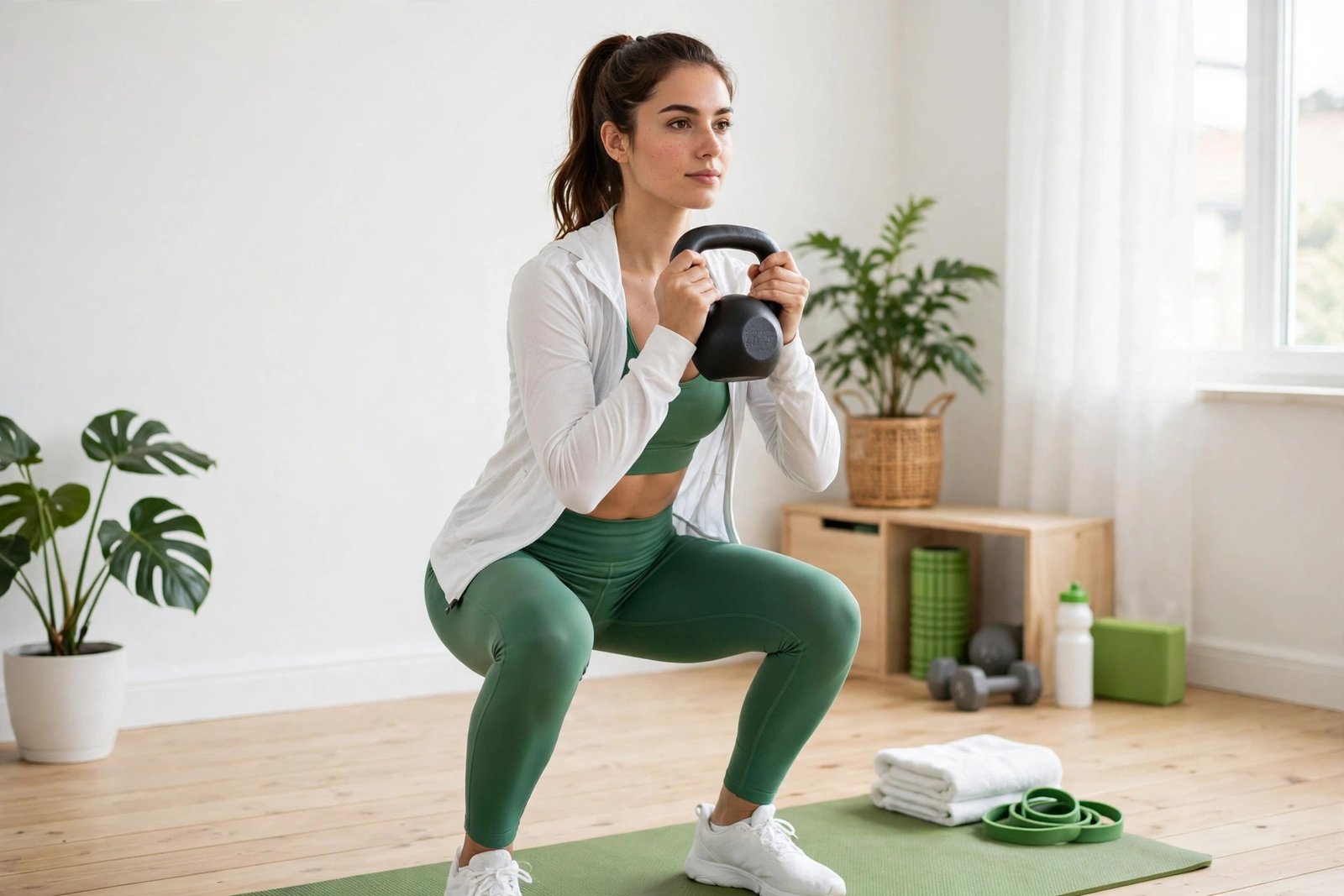
- 3. Goblet squat: hold the bell by the horns at your chest, squat down keeping your chest up and knees tracking over your toes, then drive up through your heels. This builds leg strength and teaches a deep, stable squat.
- 4. Overhead press: clean the bell to your shoulder, brace your core, and press it straight overhead until your arm is locked out. Lower it with control. This builds shoulder and tricep strength — start light, as shoulders fatigue fast.
- 5. Farmer's carry: pick up a bell in each hand (or one, and switch sides) and walk tall with a tight core and relaxed shoulders. It sounds simple, but it builds grip, core, and posture like few other moves.
Once these five feel solid, the Turkish get-up is the natural next step — a slow, controlled move from lying down to standing while holding a bell overhead. It is the best full-body stability exercise in the kettlebell world, but learn it unweighted first, or with a coach, because it has many steps.
Your first 20-minute kettlebell workout
This simple session is all you need to start. Do it two or three times a week, with at least one rest day between sessions.
Warm-up (5 minutes): march in place for 1 minute, then do 10 bodyweight squats, 10 hip hinges without a bell, 10 arm circles each way, and 30 seconds of gentle marching. Your hips and shoulders should feel warm and loose before you pick up the bell.
Main workout — 3 rounds, resting 60–90 seconds between rounds:
- Kettlebell deadlift — 10 reps
- Two-handed swing — 10 reps
- Goblet squat — 8 reps
- Overhead press — 6 reps per side
- Farmer's carry — 30 seconds
Cool-down (3 minutes): walk slowly for a minute, then hold a gentle hamstring stretch and a hip-flexor stretch for 30 seconds each side. Breathe slowly and let your heart rate come down.
The whole workout takes about 20 minutes. If a move feels shaky, drop the weight or the reps — finishing with good form matters far more than finishing fast. To track your sessions and see your progress over time, use the exercise tool to log each workout.
Common kettlebell mistakes to avoid
- Squatting the swing: the swing is a hinge, not a squat. If your knees bend a lot and your hips drop low, you are squatting — push your hips back instead.
- Using your arms instead of your hips: if your shoulders are tired after swings, your arms are doing the lifting. Your arms should stay relaxed; the power comes from the hip snap.
- Rounding your back: a rounded back under load is the fastest route to injury. Keep your chest up and your back flat on every rep, especially when you are tired.
- Going too heavy too soon: a bell you cannot control will control you. Earn the heavier weight with clean reps first.
- Skipping the warm-up: cold hips and shoulders make bad form more likely. Five minutes of warm-up is never wasted time.
How often should beginners train with kettlebells?
Two to three sessions a week is the sweet spot for beginners. That gives your muscles and nervous system time to recover and adapt between sessions, which is when you actually get stronger. Training every day as a beginner usually means worse form and slower progress, not faster.
Progress slowly and simply. When you can finish all three rounds of the workout above with clean form and feel you could do more, add two reps to one move — or move up to the next bell size. Small, steady jumps beat big leaps. After four to six weeks of consistent training, most beginners are ready to add the Turkish get-up or a new move, and to build a more varied programme. Our 4-week strength training plan is a good next step, and if you want a no-equipment day between kettlebell sessions, try our home workouts without equipment.
Key takeaways
- Kettlebell training for beginners builds strength and cardio at the same time, with one simple, affordable piece of equipment.
- Learn the hip hinge first — your hips power the swing, not your arms or your lower back.
- Start light: most women begin with 8–12 kg and most men with 12–16 kg.
- Master five moves first: deadlift, two-handed swing, goblet squat, overhead press, and farmer's carry.
- A 20-minute workout, 2–3 times a week, is enough to start seeing real progress.
- Stop if your lower back hurts, and never sacrifice form to lift heavier.
Frequently Asked Questions
Is kettlebell training good for beginners?
Yes — kettlebells are one of the best tools for beginners because a single bell trains strength, cardio, grip, and core at the same time. The key is to start light, learn the hip hinge before swinging, and practise the basic moves slowly. Most people can learn the five beginner moves in a few weeks with two or three short sessions a week.
What weight kettlebell should a beginner start with?
Most women start with 8–12 kg and most men with 12–16 kg. If you are new to exercise, choose the lower end; if you already train regularly, the higher end may suit you. The right weight feels challenging for the last few reps but still lets you keep a flat back and full control. If your form breaks down, the bell is too heavy.
Can kettlebell training help with weight loss?
Yes, it can help. Kettlebell workouts burn calories and build muscle, which supports a healthy metabolism, and short full-body sessions are easier to stick to than long gym routines. But exercise alone rarely causes weight loss — you also need a calorie deficit from your diet. Use the BMR/TDEE calculator to find your daily calorie target, and the exercise tool to log your workouts.
Is the kettlebell swing bad for your back?
No — a well-performed swing actually strengthens the muscles that protect your back. Problems come from bad form: rounding the back, squatting the swing, or using a weight that is too heavy. Learn the deadlift first, keep your back flat, and let your hips power the movement. Stop immediately if you feel sharp pain in your lower back, and see a doctor if pain persists.
How often should I do kettlebell training?
Two to three times a week is ideal for beginners, with at least one rest day between sessions. This gives your muscles time to recover and grow stronger. You can stay active on rest days with walking or gentle stretching, and add a no-equipment home workout if you want extra movement without another kettlebell session.
Do I need a gym to train with kettlebells?
No — that is one of the biggest advantages. A single kettlebell and a small clear space at home are enough for a full workout, and many people train entirely at home. You only need flat shoes, a non-slip floor, and enough room to swing safely. If you prefer guidance, one or two sessions with a coach to check your form is a worthwhile investment.



Comments (0)
No comments yet. Be the first to share your thoughts!
Leave a comment