
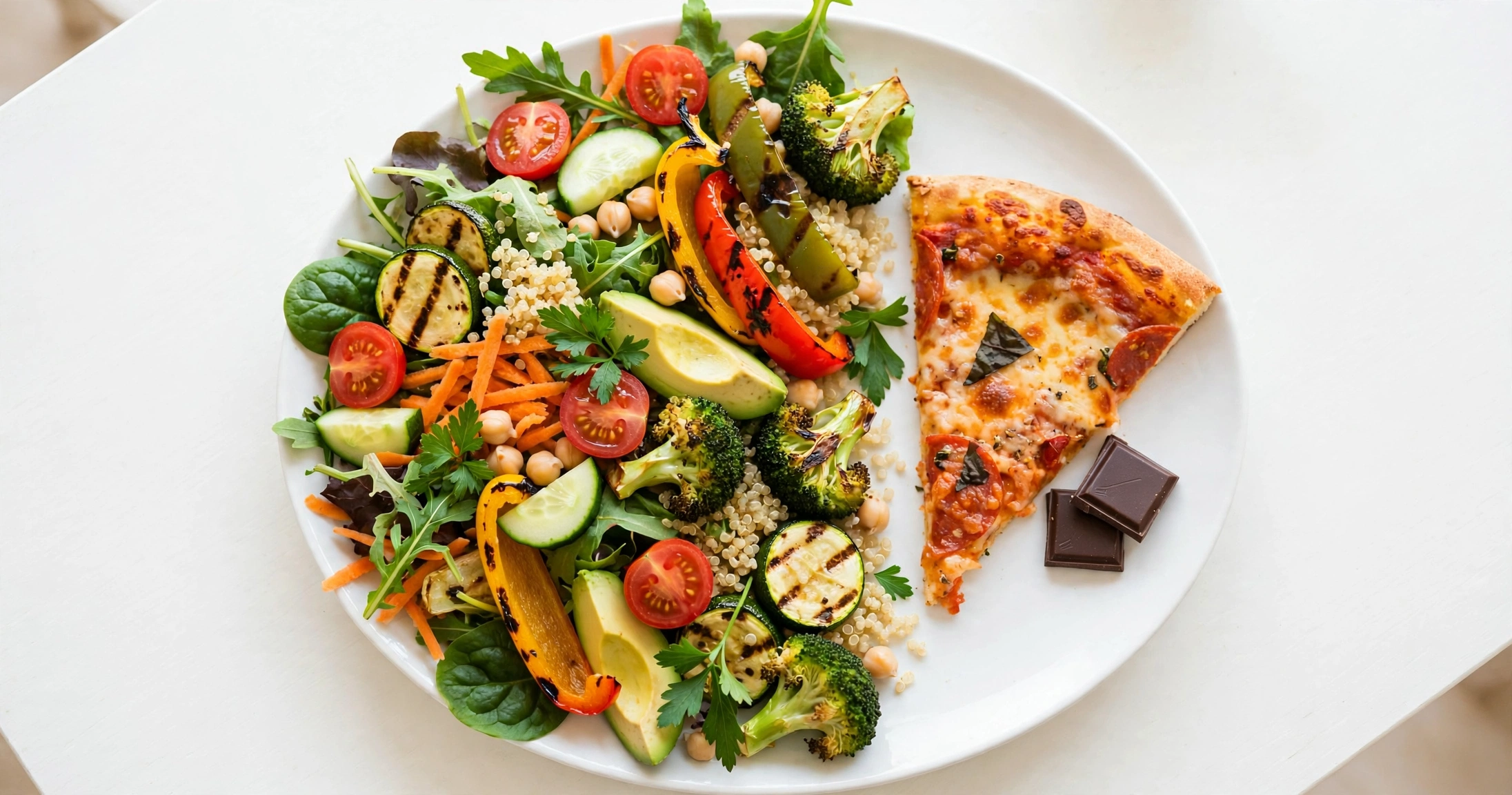
Short answer: The 80/20 rule diet means eating nutritious, whole foods 80% of the time and allowing yourself to enjoy your favorite treats the remaining 20%. It can support weight loss if your overall calorie intake stays in a deficit, and its flexible structure makes it easier to follow long-term than strict diets.
Strict diets fail for most people. Not because people lack discipline, but because banning every food you love makes eating feel like punishment — and punishment is hard to sustain. The 80/20 rule diet takes a different approach: instead of perfection, it aims for consistency, letting you enjoy pizza, chocolate, or dessert without derailing your progress.
In this guide, you'll learn exactly how the 80/20 rule diet works, what to eat on the "80" side, how to enjoy the "20" side guilt-free, and how to tell whether this approach fits your goals.
Key takeaways
- The 80/20 rule diet means 80% of your food is nutrient-dense, and 20% can be treats.
- Weight loss still requires a calorie deficit — the ratio only works if total intake stays below what you burn.
- Track your 80/20 balance by meals (e.g., 17 of 21 weekly meals clean) rather than by individual bites.
- The approach suits people who quit strict diets; it's less effective if "20%" slowly becomes "40%."
What Is the 80/20 Rule Diet?
The 80/20 rule diet is a flexible eating approach — not a rigid diet plan. The idea is simple: about 80% of the time you eat nutritious, minimally processed foods, and about 20% of the time you enjoy whatever you want without guilt. There's no official rulebook, no banned foods, and no calorie counting required (though counting can help).
The concept borrows from the Pareto principle, but in nutrition it's a loose guideline rather than a proven formula. The 80/20 split is a mindset tool: it reframes healthy eating as "most of the time" instead of "all of the time," which is a far more realistic target for most people.
What the "80%" Looks Like
Your 80% meals should be built around nutrient-dense foods that keep you full and energized:
- Vegetables and fruits — fill half your plate at most meals.
- Lean proteins — chicken, fish, eggs, legumes, tofu, low-fat dairy.
- Whole grains — oats, brown rice, quinoa, whole-wheat bread.
- Healthy fats — olive oil, nuts, seeds, avocado.
- Water — your default drink instead of sugary sodas or juices.
If you're new to structuring balanced meals, our meal prep for beginners guide shows how to build a week of healthy eating with minimal effort.
What the "20%" Looks Like
The remaining 20% is for the foods you genuinely enjoy: ice cream with friends, birthday cake, a burger on Friday night. The key word is planned — the 20% works best when it's a conscious choice rather than an impulse. Enjoy it, savor it, and move on without guilt.
How to Apply the 80/20 Rule Diet in Practice
Counting every bite as 80 or 20 is exhausting, so most people track by meals. A common pattern: out of 21 weekly meals (3 per day), aim for 17 nutritious meals and allow 4 flexible ones. Snacks can follow the same rough ratio.
To keep your portions honest without obsessive tracking, check out portion control without counting calories. And if you want precise numbers on where you stand, our free calorie tracker makes it easy to see your 80/20 balance across the week.
Does the 80/20 Rule Diet Actually Work for Weight Loss?
Here's the honest answer: the 80/20 rule diet can support weight loss, but only under one condition — your total calorie intake must stay below what your body burns. No eating pattern overrides energy balance. If your 80% is clean but your 20% regularly includes 2,000-calorie restaurant meals, the math won't work.
That said, the approach has real strengths:
- Adherence. The main reason diets fail is that people quit. A plan that includes your favorite foods is one you're more likely to follow for months, and consistency beats perfection for weight loss.
- No binge-rebound cycle. Complete restriction often leads to bingeing. Planned treats reduce the psychological pressure that triggers overeating.
- Social flexibility. You can eat at restaurants, attend parties, and live a normal life without anxiety.
The main weakness is the "20% creep" — where occasional treats gradually expand into half your diet. Keeping a simple meal log helps you notice when the ratio drifts before it stalls your progress.
Sample Day on the 80/20 Rule Diet
Here's what a balanced day can look like when most meals land in the 80% zone:
- Breakfast: Oatmeal with berries, a spoonful of peanut butter, and a boiled egg.
- Lunch: Grilled chicken salad with mixed greens, chickpeas, olive oil, and whole-grain bread.
- Snack: An apple with a small handful of almonds.
- Dinner (your 20% meal): Two slices of your favorite pizza with a side salad — enjoyed slowly, no guilt.
Notice that the treat meal isn't a free-for-all: it's a normal, satisfying portion. For healthy snack ideas between meals, see our list of healthy snacks under 200 calories.
Who Should (and Shouldn't) Try the 80/20 Rule Diet
The 80/20 rule diet suits people who have a history of quitting strict diets, who eat reasonably well already, or who need flexibility for social life and travel. It's a maintenance-friendly approach that can transition smoothly into long-term habits.
It's less ideal if you need strict medical nutrition guidance (for example, diabetes management or food allergies require professional supervision), or if "a little treat" reliably turns into a full binge for you — in that case, more structure may help more.
Tips for Making the 80/20 Rule Diet Work
- Plan your 20% in advance. Decide which meals are flexible at the start of the week so treats are intentional, not accidental.
- Keep the 80% genuinely nutritious. "Healthy-ish" processed food doesn't build the same satiety as whole foods.
- Know your calorie target. Use our BMR/TDEE calculator to find your daily needs, then check your BMI to set a realistic goal. For the science of sustainable deficits, read what a calorie deficit really is.
- Track loosely, review weekly. A rough weekly check-in beats daily micromanagement.
- Adjust the ratio if needed. Some people do better at 90/10 — the numbers are guidelines, not law.




Comments (0)
No comments yet. Be the first to share your thoughts!
Leave a comment